Remedy profile
Borax in Homeopathy: Uses, Picture and Limits
What homeopathic Borax is made from, the hot mouth-ulcer and fear-of-falling picture homeopaths describe, what changes it, potencies sold, and its limits.
By Homeopathic BenefitsPublished 7 min read
Key takeaways
- Borax is the classic canker-sore picture of the older books. Homeopathic literature describes hot, tender mouth ulcers that bleed on touch and turn every salty or sour mouthful into an event.
- Its strangest keynote is a dread of downward motion. Classic texts describe the baby who startles and grips when laid down, and the adult who hates going downstairs or descending in a lift.
- Sudden noises jar the whole picture. A sneeze, a cough or a slammed door across the room makes the person jump far more than the noise deserves.
- It is prepared from household borax, which is not harmless. Sodium borate in material amounts is harmful if swallowed, especially by infants; potentised preparations are diluted far past the point where any is expected to remain.
- Mouth red flags come first. An ulcer that lasts more than three weeks, white patches in a baby's mouth, a baby who will not feed, or ulcers with fever and feeling unwell are questions for a clinician before any pattern discussion.
The short answer
Borax is a homeopathic remedy prepared from sodium borate, the white mineral salt of boron better known as a cleaning powder, triturated with milk sugar and then diluted and succussed to the labelled potency. In homeopathy it names a traditional picture rather than a treatment: a hot, sore mouth with tender ulcers that bleed easily, together with a nervous oversensitivity to sudden noise and an odd dread of downward motion. Classic materia medica describes it most vividly in nursing infants with sore mouths who cry when laid down. Hahnemann included it in The Chronic Diseases, and Boericke (1927) gives the fear of downward motion first place in his entry. It is not a mouth-ulcer remedy, and nothing about the picture replaces a clinician's look at an ulcer that will not settle.
| Latin name | Borax |
|---|---|
| Abbreviation | Bor. |
| Common name | Borax (sodium borate) |
| Source | Sodium tetraborate (borax), a naturally occurring mineral salt of boron, triturated and potentised (mineral kingdom) |
| Commonly sold potencies | 6C, 30C |
| First proving | Included in Hahnemann's The Chronic Diseases (second edition, 1835–1839) |
What is Borax made from?
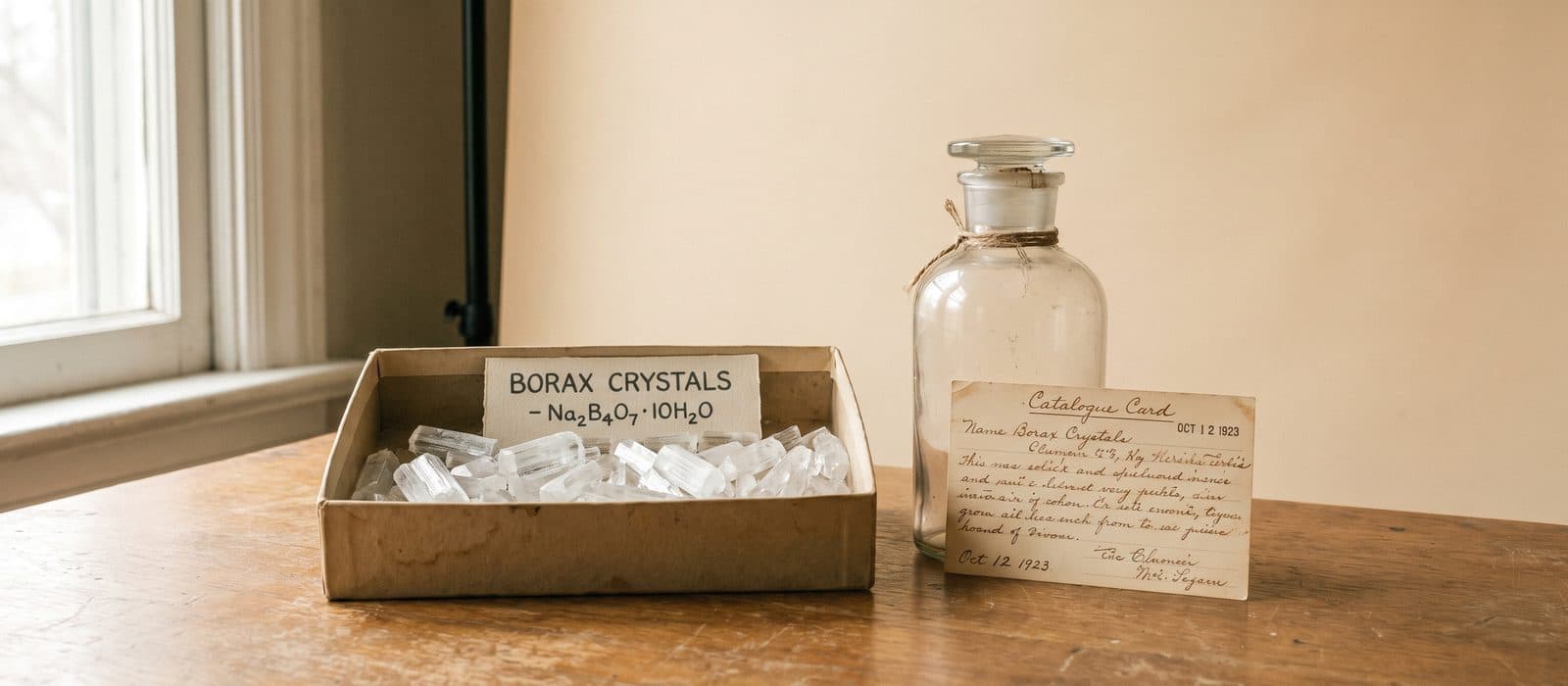
Homeopathic Borax is prepared from sodium tetraborate, a soft, white, crystalline mineral salt. It forms naturally where salt lakes evaporate in dry country, and the old trade name Borax veneta records the Venetian refiners who handled it when it came overland from Tibet and Persia. Today most borax comes from large deposits in California and Turkey. It has been used for centuries as a flux in metalwork, a glaze in ceramics and a laundry and cleaning powder.
It is also, for the same reasons, a substance to keep away from children. Borax is harmful if swallowed in material amounts, irritates the eyes and skin, and boron compounds are classed in Europe as a reproductive hazard. Borax and honey or borax and glycerine were once painted on babies' sore mouths; that practice was abandoned in the twentieth century once infant poisonings from absorbed boron were recognised. None of this page refers to household borax as anything other than a cleaning product.
The homeopathic preparation grinds the salt with lactose (trituration) through the first steps, then carries it through repeated dilution and succussion. At the common potencies the arithmetic says no molecule of the original salt is expected to remain. Our potencies guide explains that honestly, including why it is also the reason mainstream science is sceptical, and the guide to reading Latin remedy names explains how labels name mineral sources.
What is the Borax picture?
The Borax picture has two halves that seem unrelated until you see them in the same small child. The first is the mouth. The inside of the cheeks, the gums or the tongue carry small, hot, white-based ulcers that bleed when touched; the mouth feels hot to the person and to a finger; nursing or eating is painful, so the baby lets go of the breast and cries. Salty, sour and acidic food stings. Classic texts add that the mouth may be dry, or that the ulcers seem to come back with each upset.
The second half is the nerves. Boericke (1927) puts the dread of downward motion at the head of his entry: the infant who is happy enough held, but startles, throws out its arms and clings the moment it is lowered into the cot. The old texts describe adults with the same feeling going downhill, down stairs or descending in a lift. Sudden sounds land the same way: a sneeze, a cough, the crack of a branch, a door. The person jumps far beyond what the noise warrants and is unsettled afterwards.
Around those two keynotes the old texts add smaller details: a child who is anxious and cross during illness, hair that tangles easily at the ends, and white, slippery discharges that feel warm. Hahnemann's Chronic Diseases and Hering's Guiding Symptoms record them; most modern discussions keep only the mouth and the fear of falling.
What makes it better or worse?
The traditional modalities centre on motion, noise and warmth. Borax is worse from downward movement, sudden noise and warm weather, and better from pressure and in the evening.
| Modality | Worse | Better |
|---|---|---|
| Motion | Downward motion: being laid down, going downstairs, a descending lift | Being held still |
| Senses | Sudden noises, even slight ones | Quiet |
| Food | Salty, sour and acidic food on the ulcers | Bland, cool food |
| Temperature | Warm weather | Cool weather (Boericke) |
| Other | Smoking (Boericke) | Pressure; the evening |
Downward motion is one of the most unusual modalities in the materia medica, and our guide to modalities, better and worse explains why an oddity like this carries more weight than a common complaint.
What is Borax traditionally discussed for?
In homeopathic literature, Borax is traditionally discussed for sore, hot, touch-sensitive mouths and a startle-prone nervous state. It appears on one of our acute pages, where the Borax-like pattern sits beside its neighbours and the red flags come first.
Mouth
- The hot-feeling, tender ulcer that makes salty and acidic food an event, in a mouth that objects to warmth: a painful canker sore.
Where the old texts take it further
- Classic materia medica also describes the picture in nursing infants with sore mouths who cry at the breast and when laid down. White patches in a baby's mouth are usually oral thrush and need a clinician's assessment; our guide to observing a sick child covers what to note before that conversation.
What is Borax not?
Borax is not "the mouth-ulcer remedy", and it is not a reason to use household borax for anything that goes in the mouth. The common misreading is to see "canker sore" and stop there; the tradition's picture is the ulcer plus the heat, the bleeding on touch, the stinging from salt and acid, and ideally the nervous startle that runs alongside. An ordinary ulcer without those companions belongs elsewhere. An ulcer that lasts more than three weeks, one that is painless and hard, white or red patches that do not rub off, many ulcers with fever and feeling unwell, or a baby who refuses feeds or shows signs of dehydration (fewer wet nappies, a dry mouth, sunken soft spot) are reasons to see a clinician first.
Homeopaths separate Borax from its neighbours like this:
| Picture | Where it sits | Defining feature | Key modality |
|---|---|---|---|
| Borax | Hot, tender mouth ulcers; startle | Ulcers bleed on touch; dread of downward motion | Worse sudden noise and warmth; better pressure |
| Mercurius | Ulcers with heavy salivation | Drooling, metallic taste, offensive breath | Worse at night and from both heat and cold |
| Natrum muriaticum | Recurrent ulcers after strain or grief | Reserved, dislikes consolation; dry, cracked lips | Worse sun and heat; better open air |
| Hydrastis | Thick, ropy mucus states | Yellow, stringy discharges; raw membranes | Worse raw air; better rest |
What potencies is Borax sold in?
Borax is sold as 6C and 30C pellets by most homeopathic manufacturers, and higher potencies are available from specialist pharmacies. It is not a standard item in most home kits and is found more often at homeopathic pharmacies than on general shelves. Potency describes the preparation process, not an amount of borax: 30C means thirty successive 1:100 dilutions with succussion between them. Our potencies guide explains the scale and what remains in the vial.
This page deliberately gives no frequency or instructions for taking Borax. That depends on a whole case, not a remedy name. Read the product label, and talk to a qualified practitioner about an individual situation.
What remedy lists don't tell you
Two things the canker-sore lists leave out:
- The startle is the part that identifies it. Mouth ulcers are common and many traditional pictures include them. A child or adult who also jumps at a cough in the next room, or clutches at the banister going downstairs, gives the description something no other mouth picture has. Homeopaths value that kind of strange, specific companion far above the main complaint; our guide to the symptoms alongside the symptom explains why.
- The remedy and the household product share only a name. People who read "Borax for mouth ulcers" sometimes go looking for borax powder. That is a cleaning chemical, harmful if swallowed, and the old habit of painting it on babies' mouths was given up because it poisoned some of them. The red flags first guide is the better starting point for a sore mouth that is not settling.
Where the Borax picture appears on this site
Acute pages that discuss this picture among their educational patterns, with the pattern name each page uses.
- What homeopathic remedy for a painful canker sore?Borax-like sensitive mouth-ulcer pattern
Not sure whether a picture fits?
A remedy profile describes a picture; it cannot tell you whether that picture matches what you are seeing. An acute consultation starts from the case itself: onset, sensations, what changes it, and the red flags.
Acute consultation · $45Frequently asked questions
- What is Borax?
- Borax is a homeopathic remedy prepared from sodium borate, the white mineral salt sold for generations as a household cleaner. In homeopathy it names a traditional picture with two unusual keynotes: hot, tender mouth ulcers that bleed easily and make eating an ordeal, and a marked dread of downward motion, classically the baby who startles and clings when laid down. It is a description homeopaths use to compare cases, not evidence that it works for any condition.
- What is Borax used for in homeopathy?
- Homeopathic literature traditionally discusses Borax for sore, hot, touch-sensitive mouth ulcers, especially when salty or acidic food stings and the mouth feels hot, and for a nervous startle at sudden noises and downward movement. The picture is defined by those keynotes together rather than by the name of a complaint. Mouth ulcers that last more than three weeks, white patches in a baby's mouth, or a baby who will not feed need a clinician first.
- What is Borax 30C used for?
- 30C is one of the two potencies Borax is commonly sold in, alongside 6C, though it is stocked mainly by homeopathic pharmacies rather than general shops. In the tradition, the potency does not change the picture; Borax 30C is discussed for the same hot mouth-ulcer, startle-prone picture as any other potency. What 30C means as a dilution is explained in our potencies guide.
- How is Borax taken?
- This page does not give instructions on how or how often to take any remedy, because that depends on a whole case rather than on a remedy name. The product label carries the manufacturer's directions, and a qualified practitioner can advise on an individual situation. Household borax is a different product altogether and is never something to put in the mouth.
- Where can I buy Borax?
- Homeopathic pharmacies and manufacturers sell Borax as single-remedy pellets, usually in 6C or 30C; it is less common on general pharmacy shelves. This site also prepares custom single remedies to order: you name the remedy and potency, and the details are confirmed by email before anything is made. The order form does not give advice on which remedy to choose.
- What is Borax made from?
- Homeopathic Borax is made from sodium tetraborate, a mineral salt that forms in the dry beds of evaporated salt lakes. It is ground with milk sugar (trituration) through the first potency steps, then diluted and succussed to the labelled potency. Borax in material amounts is harmful if swallowed, especially by children, and boron compounds were dropped from baby mouth preparations for that reason.
This guide is educational only and is not medical advice or a personalized remedy recommendation. Acute symptoms can become urgent; when in doubt, seek professional evaluation.