Remedy profile
Bovista in Homeopathy: Uses, Picture and Limits
What homeopathic Bovista is made from, the puffy, clumsy, easily marked picture homeopaths describe, what changes it, potencies sold, and its limits.
By Homeopathic BenefitsPublished 7 min read
Key takeaways
- Bovista is the picture of puffiness that holds a dent. Homeopathic literature describes tissue so soft and swollen that scissor handles, a ring or a watch strap leave a deep mark.
- Clumsiness belongs to the same picture. Classic texts describe a person who fumbles, drops things and is awkward with their hands, and a child who stammers.
- It is a minor remedy with a thin literature. Boericke (1927) and Clarke's Dictionary (1900–1902) give it a page; most of what is said about it beyond that is repetition.
- It comes from a puffball fungus. The source is the dry spore mass of a meadow puffball; breathing in clouds of spores can inflame the lungs, and wild puffballs are easily confused with poisonous fungi.
- Swelling has red flags first. One leg swollen, hot and painful, swelling with breathlessness or chest pain, or sudden swelling of the face, lips or tongue is a medical question before any pattern discussion.
The short answer
Bovista is a homeopathic remedy prepared from the ripe spores of the warted puffball, Lycoperdon bovista, a round meadow fungus that bursts into brown dust when it is pressed. In homeopathy it names a traditional picture rather than a treatment: puffiness of the skin and tissues, so that anything pressed against them leaves a lasting dent, together with clumsiness, itchy or weeping skin, and a tendency to bleed easily, especially from the nose. Classic materia medica recorded it from nineteenth-century provings, and Boericke (1927) gives it a short entry built around those features. It is a minor remedy, it is not a swelling remedy, and nothing about the picture replaces medical care for swelling that is new, one-sided or accompanied by breathlessness.
| Latin name | Bovista |
|---|---|
| Abbreviation | Bov. |
| Common name | Warted puffball |
| Source | Ripe spore mass of the puffball fungus Lycoperdon bovista (Bovista lycoperdon) (plant kingdom) |
| Commonly sold potencies | 6C, 30C |
| First proving | Proved in the nineteenth century; recorded in Allen's Encyclopedia of Pure Materia Medica (1874–1879) |
What is Bovista made from?
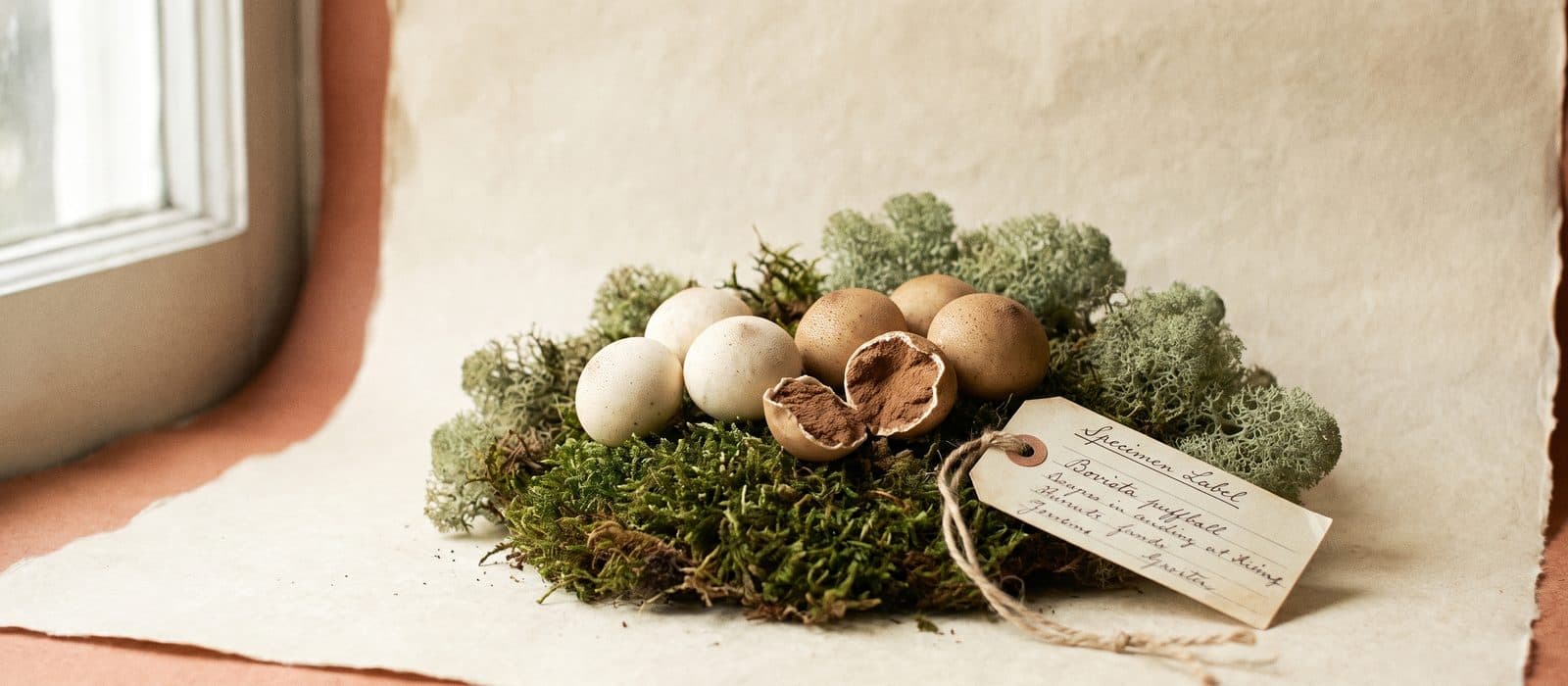
Homeopathic Bovista is prepared from the warted puffball, Lycoperdon bovista, also listed as Bovista lycoperdon. Puffballs are round fungi with no gills and no stem to speak of; they grow in meadows, lawns and pasture in late summer and autumn. Young puffballs are firm and white all the way through. As they ripen, the inside turns into a mass of olive-brown spores, the skin dries to a papery shell, and a raindrop or a footstep sends up a puff of brown dust. The genus name Lycoperdon is old Greek humour; it translates roughly as "wolf's fart".
The remedy uses that ripe spore mass. In folk medicine, puffball dust was packed into wounds to stop bleeding, and beekeepers burned puffballs to calm bees. Two honest cautions apply to the raw fungus. Inhaling large amounts of puffball spores can cause a lung inflammation known as lycoperdonosis, recorded mainly in children who played with or deliberately sniffed puffballs. And foragers can confuse young puffballs with the button stage of deadly Amanita species or with poisonous earthballs; none of this page is a foraging guide.
The homeopathic preparation grinds the spores with lactose (trituration) through the first steps, then carries them through repeated dilution and succussion. At the common potencies the arithmetic says nothing of the original spores is expected to remain; our potencies guide explains what that means, and why it is also the reason mainstream science is sceptical.
What is the Bovista picture?
The Bovista picture is the person whose body seems slightly too soft for its own good. Imagine someone who takes off their watch at the end of the day to find a deep groove that is still there an hour later; whose fingers swell so that the handles of scissors leave a red, dented print; whose ankle, after a minor twist or an insect bite, puffs up more than the injury seems to justify and stays puffy and awkward rather than hot and angry.
Boericke (1927) gathers that puffiness together with clumsiness. The person drops things, knocks things over and is awkward with their hands; the old texts describe stammering children in the same breath. Clarke's Dictionary adds a dull, slow, slightly bewildered quality to the mind, as if the head itself were swollen. Bleeding comes easily: nosebleeds, especially in the morning, and bleeding gums.
The skin completes the description. Classic texts record itching that is worse from warmth, weeping eczema that forms thick crusts, acne made worse by cosmetics, and hives that rise with excitement. In women the old texts add period-related complaints, such as diarrhoea before and during a period. Taken together, it is a loose, oozing, slightly sluggish picture rather than a hot, inflamed one.
What makes it better or worse?
The traditional modalities are sparse, and the old texts agree on only a few. Bovista is worse from warmth and better from bending double when there is colic.
| Modality | Worse | Better |
|---|---|---|
| Temperature | Warmth, including warm food; itching worse when warm | No consistent keynote |
| Pressure | Tight objects leave deep marks | Removing rings, straps and tight clothing |
| Position | Sitting upright with colic | Bending double with colic |
| Time | Morning, for nosebleeds | No consistent keynote |
| Other | The full moon, in some older texts | No consistent keynote |
A thin modality list is itself useful information. Our guide to modalities, better and worse explains how homeopaths read them, and why a remedy with few recorded modalities is rarely the first picture they consider.
What is Bovista traditionally discussed for?
In homeopathic literature, Bovista is occasionally discussed for puffy, awkward swelling and the oozing, itchy skin that goes with it. It appears on one of our acute pages, where the Bovista-like pattern sits beside its neighbours and the red flags come first.
Swelling
- Awkward puffiness after a minor knock or an allergic flare, where the tissue holds a dent: mild leg swelling.
Where the old texts take it further
- Classic materia medica also describes itchy, weeping, crusting skin and hives that rise with excitement, and a tendency to nosebleeds. Those descriptions are not linked here because our acute pages do not discuss Bovista for them; a sudden nosebleed has its own page with its own patterns and red flags.
What is Bovista not?
Bovista is not a remedy for swollen legs, and the gap between "puffy" and "swollen" is where the red flags live. Swelling that holds a dent when pressed (pitting oedema) can come from a long flight or a hot day, but it can also come from the heart, the kidneys, the liver, a blood clot or medication. One calf swollen, warm and painful can be a deep vein thrombosis; swelling with breathlessness, chest pain or coughing up blood needs emergency care; sudden swelling of the face, lips or tongue, especially with difficulty breathing or swallowing, is anaphylaxis until proved otherwise. New swelling in both legs that does not settle overnight, or that comes with weight gain, belongs with a clinician.
Homeopaths separate Bovista from its neighbours like this:
| Picture | Where it sits | Defining feature | Key modality |
|---|---|---|---|
| Bovista | Puffy, awkward swelling | Tissue holds a dent; clumsy, drops things | Worse warmth |
| Apis mellifica | Hot, stinging, shiny swelling | Rosy, water-filled, stinging; thirstless | Worse heat and touch; better cold applications |
| Natrum muriaticum | Fluid retention | Reserved, craves salt; puffiness with the cycle | Worse sun and heat; better open air |
| Urtica urens | Hives and nettle-type rashes | Burning, stinging blotches | Worse cool bathing and touch |
What potencies is Bovista sold in?
Bovista is sold as 6C and 30C pellets by homeopathic manufacturers, with other potencies made to order. It is a specialist item: general pharmacies rarely stock it and it is not part of standard home kits. Potency describes the preparation process, not an amount of fungus: 30C means thirty successive 1:100 dilutions with succussion between them. Our potencies guide explains the scale and what remains in the vial.
This page deliberately gives no frequency or instructions for taking Bovista. That depends on a whole case, not a remedy name. Read the product label, and talk to a qualified practitioner about an individual situation.
What remedy lists don't tell you
Two things the short lists leave out:
- Minor remedies carry less certainty, not more. A remedy with a few pages of nineteenth-century provings has been described by fewer people, compared with fewer neighbours and repeated with less checking than the household names. Lists present Bovista with the same confidence as Arnica. An honest reading gives it less weight, and our guide to the symptoms alongside the symptom explains why homeopaths look for several confirming features before naming a minor picture.
- The dent is an observation anyone can make, and a doctor wants to hear about it too. Pressing a thumb into a swollen ankle and watching whether the dent stays is exactly what a clinician does to assess oedema. The old Bovista keynote and the modern examination overlap, which is a reason to report it, not to sit on it. The guide to homeopathy alongside conventional care covers how the two conversations fit together.
Where the Bovista picture appears on this site
Acute pages that discuss this picture among their educational patterns, with the pattern name each page uses.
- What homeopathic remedy for mild leg swelling?Bovista-like puffy, awkward swelling pattern
Not sure whether a picture fits?
A remedy profile describes a picture; it cannot tell you whether that picture matches what you are seeing. An acute consultation starts from the case itself: onset, sensations, what changes it, and the red flags.
Acute consultation · $45Frequently asked questions
- What is Bovista?
- Bovista is a homeopathic remedy prepared from the ripe spores of a puffball fungus, Lycoperdon bovista. In homeopathy it names a traditional picture built around puffiness: tissue that swells awkwardly and holds a dent, so that scissor handles or a watch strap leave a deep mark, together with clumsiness and a tendency to drop things. It is a description homeopaths use to compare cases, not evidence that it works for any condition.
- What is Bovista used for in homeopathy?
- Homeopathic literature occasionally discusses Bovista for awkward, puffy swelling after minor knocks or allergic reactions, and the older texts add itchy, weeping skin, nosebleeds and a clumsy, fumbling quality. It is a minor remedy with a thin literature. Swelling of one leg with heat and pain, swelling with breathlessness, or sudden swelling of the face, lips or tongue needs medical care first.
- What is Bovista 30C used for?
- 30C is one of the potencies Bovista is sold in, though it is a specialist item rather than a shelf remedy and usually has to be ordered from a homeopathic pharmacy. In the tradition, the potency does not change the picture; Bovista 30C is discussed for the same puffy, easily marked, clumsy picture as any other potency. What 30C means as a dilution is explained in our potencies guide.
- How is Bovista taken?
- This page does not give instructions on how or how often to take any remedy, because that depends on a whole case rather than on a remedy name. The product label carries the manufacturer's directions, and a qualified practitioner can advise on an individual situation. New or one-sided swelling belongs with a clinician first.
- Where can I buy Bovista?
- Homeopathic pharmacies and manufacturers sell Bovista as single-remedy pellets, usually in 6C or 30C; it is rarely found on general pharmacy shelves or in home kits. This site also prepares custom single remedies to order: you name the remedy and potency, and the details are confirmed by email before anything is made. The order form does not give advice on which remedy to choose.
- What is Bovista made from?
- Homeopathic Bovista is made from the ripe, powdery spore mass of the warted puffball, a round fungus of meadows and pastures. The spores are ground with milk sugar (trituration) through the first potency steps, then diluted and succussed to the labelled potency. Breathing in large clouds of puffball spores can inflame the lungs, which is one reason the raw spore dust is not something to play with.
This guide is educational only and is not medical advice or a personalized remedy recommendation. Acute symptoms can become urgent; when in doubt, seek professional evaluation.