Remedy profile
Euphrasia officinalis in Homeopathy: Uses, Picture and Limits
What homeopathic Euphrasia is made from, the streaming, gritty-eyed picture homeopaths describe, what changes it, the potencies sold, and its limits.
By Homeopathic BenefitsPublished 7 min read
Key takeaways
- Euphrasia is the picture of streaming, gritty eyes. Profuse tears, a sensation of sand under the lids and eyes that shrink from light are its classic keynotes.
- The eyes lead, the nose follows. Classic texts describe smarting, burning tears with a running nose that is mild and bland by comparison.
- The detail is in the discharges. Homeopaths compare which discharge stings and which does not, and that comparison separates Euphrasia from its closest neighbour.
- It comes from eyebright, a harmless meadow herb. Its folk name records a long tradition of use for the eyes, which is history rather than evidence.
- Eye red flags come first. Real pain rather than grittiness, blurred or reduced vision, a chemical splash, an injury or a contact-lens wearer with a red eye needs prompt medical care.
The short answer
Euphrasia is a homeopathic remedy prepared from eyebright, Euphrasia officinalis, a small flowering herb of European meadows and heaths. In homeopathy it names a traditional picture rather than a treatment: eyes that stream with smarting tears, feel full of sand and cannot bear light, usually with a running nose that is mild by comparison. Classic materia medica places the eyes at the centre and the nose and cough as companions, worse in the evening and indoors. Hahnemann documented it in his Materia Medica Pura, and Boericke (1927) still described it chiefly as an eye remedy. It is not an eye remedy for every red eye, and nothing about the picture replaces an eye examination when there is pain, a change in vision or an injury.
| Latin name | Euphrasia officinalis |
|---|---|
| Abbreviation | Euphr. |
| Common name | Eyebright |
| Source | Whole fresh flowering plant of Euphrasia officinalis (Orobanchaceae) (plant kingdom) |
| Commonly sold potencies | 6C, 30C |
| First proving | Hahnemann, Materia Medica Pura (1811–1821) |
What is Euphrasia made from?
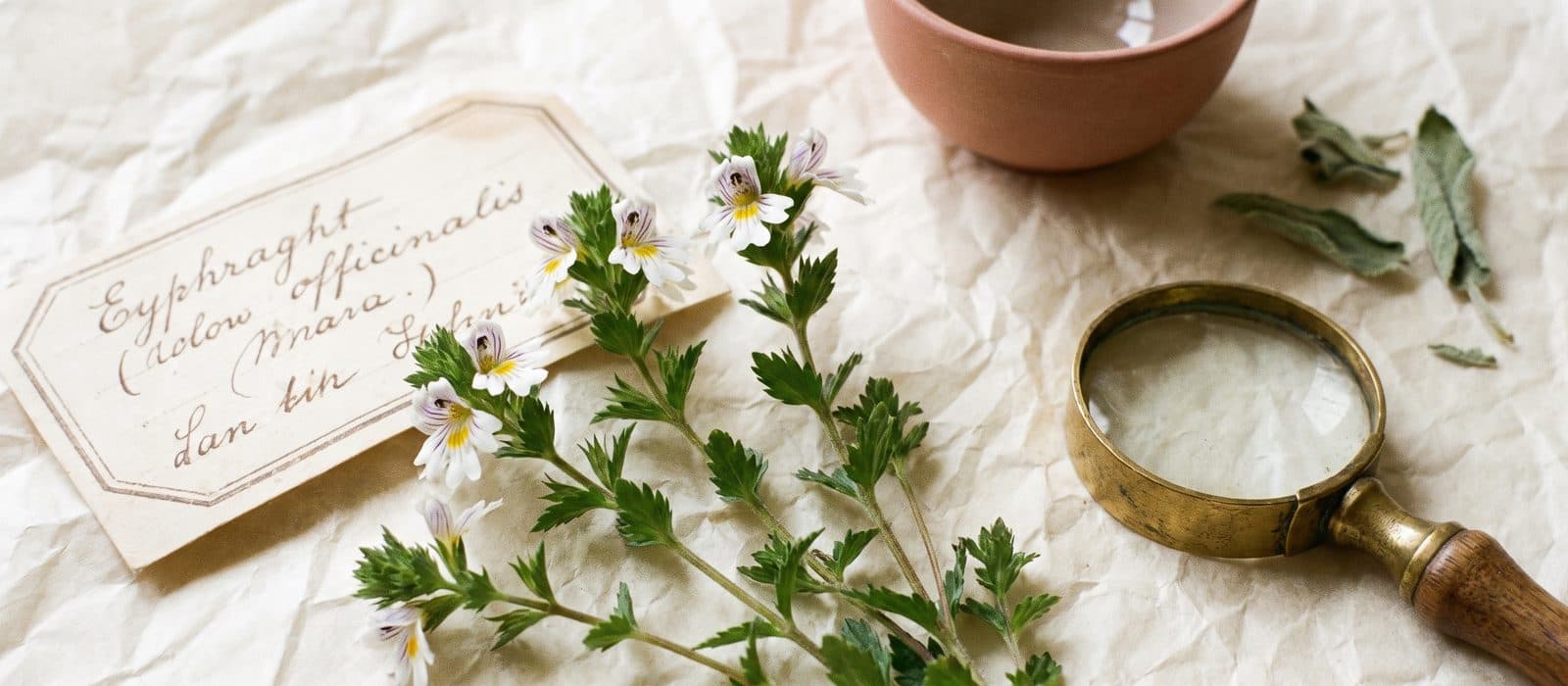
Homeopathic Euphrasia is prepared from the whole fresh plant of Euphrasia officinalis, eyebright, gathered while it is in flower. It is a low annual herb, rarely more than a hand's height, with small toothed leaves and tiny white flowers marked with purple veins and a yellow spot at the throat. It grows in short grassland, meadows and heaths across Europe, and it is semi-parasitic: its roots tap into the roots of neighbouring grasses for part of their water and nutrients. Botanists once placed it in the figwort family; most now place it in the broomrape family (Orobanchaceae).
The common name is old. The flower was said to look like a bright, bloodshot eye, and under the doctrine of signatures that resemblance marked it as a plant for the eyes. Medieval and Renaissance herbals recommended eyebright washes and teas, and the folk name has outlived the theory. None of that history is evidence, and it should not be read as a reason to put any home-made preparation in an eye.
Eyebright is not a poisonous plant, so this page does not need the warnings that go with Belladonna or Nux vomica. The homeopathic preparation steeps the fresh plant into a mother tincture, then dilutes and succusses it step by step to the labelled potency. At the common potencies the arithmetic says no molecule of the plant remains; our potencies guide explains what that means and why it is also the reason mainstream science is sceptical. Our guide to what is in a homeopathic remedy covers the process in more detail.
What is the Euphrasia picture?
The Euphrasia picture is a person whose eyes will not stop running. Imagine someone on a bright, breezy June afternoon, blinking hard, dabbing at the corners of their eyes with a tissue that is already soaked. The tears are hot and smart on the cheeks, and the lid margins are red and sore. The eyes feel gritty, as though fine sand were caught under the lids, and they keep wanting to rub them. Bright light is unpleasant, and they would rather sit with their back to the window.
The nose runs too, but it is the minor partner. Classic texts describe a profuse, bland discharge from the nose that does not sting the upper lip, while the tears themselves are acrid and burning. Boericke (1927) puts that contrast at the heart of the entry: acrid tears, bland nasal discharge. There may be a cough, loose and rattling in the daytime, that eases when the person lies down at night, the reverse of most coughs.
Clarke's Dictionary (1900–1902) adds the small details that make the picture recognisable: frequent blinking, a sticky mucus that gathers on the cornea and is cleared by blinking, and eyelids that feel swollen and heavy. The person is not usually described as anxious or irritable in any special way. Euphrasia is one of the pictures where the local symptoms carry nearly all the weight and the temperament adds little.
What makes it better or worse?
The traditional modalities centre on light, warmth and the time of day. Euphrasia is worse in the evening, indoors, in warmth and in bright light, and better in the dark and in the open air.
| Modality | Worse | Better |
|---|---|---|
| Light | Bright light, sunlight | A dim or dark room |
| Place | Indoors, a warm room | Open air |
| Time | Evening | No consistent keynote |
| Weather | Wind, warm southerly winds (Boericke) | No consistent keynote |
| Position (cough) | Daytime, up and about | Lying down at night |
Our guide to modalities, better and worse explains why a homeopath asks about these before naming anything, and why two people with the same streaming eyes can belong to different pictures.
What is Euphrasia traditionally discussed for?
In homeopathic literature, Euphrasia is traditionally discussed for irritated, watering eyes where the eye symptoms dominate. Each of these appears on one of our acute pages, where the Euphrasia-like pattern sits beside its neighbours and the red flags come first.
Eyes in the allergy season
- Gritty, sandy eyes with streaming tears and smarting lid margins: gritty, irritated eyes from allergies. Our guide to seasonal acute patterns places this alongside the other pictures of the pollen months.
Pink, irritated eyes
- Eye irritation with profuse tearing and a gritty, burning feel: pink, irritated eyes with discharge. Conjunctivitis in a newborn, or a red eye in someone who wears contact lenses, is a reason to be seen promptly, and that page sets out the other red flags.
What is Euphrasia not?
Euphrasia is not "the eye remedy", and the folk name makes that misreading easy. A red, watering eye can follow several traditional pictures: the puffy, stinging, water-bag lids that want cold, the thick, yellow, bland discharge of a weepy child, the burning, anxious, chilly hay-fever sufferer. Euphrasia is the one with profuse smarting tears, grit under the lids, light sensitivity and a mild nose. Without that, eyebright on the label is only a nice name.
It is also not a reason to wait with an eye that needs examining. Real pain rather than grittiness, blurred or reduced vision, seeing haloes around lights, a pupil that looks different from the other, a chemical splash, something stuck in or struck against the eye, a red eye in a contact-lens wearer, or any eye discharge in a newborn needs prompt care from an optometrist, eye casualty or doctor. Our guide to red flags first covers how to think about these.
Homeopaths separate Euphrasia from its neighbours like this:
| Picture | Where it sits | Defining feature | Key modality |
|---|---|---|---|
| Euphrasia | Streaming, gritty eyes | Acrid tears, bland nasal discharge, light-shy | Worse evening, indoors, light; better open air and dark |
| Apis mellifica | Puffy, swollen lids | Water-bag swelling, stinging, rosy; little thirst | Worse heat; better cold applications |
| Pulsatilla | Thick, bland eye discharge | Yellow-green discharge, styes; weepy, wants company | Worse warm stuffy rooms; better open air |
| Arsenicum album | Burning hay fever | Thin, burning discharges from eyes and nose; anxious, restless, chilly | Worse cold and after midnight; better warmth |
The closest neighbour of all is Allium cepa, prepared from red onion, which the classic texts describe as the mirror image: bland tears with a burning, acrid nasal discharge that reddens the upper lip. Anyone who has chopped an onion knows the watering eyes; the tradition's point is that in the onion picture it is the nose that stings.
What potencies is Euphrasia sold in?
Euphrasia is sold most often as 6C and 30C pellets, the common shelf potencies for single remedies. Potency describes the preparation process, not an amount of plant: 30C means thirty successive 1:100 dilutions with succussion between them. Our potencies guide explains the scale and what remains in the vial. Some European manufacturers also sell Euphrasia eye drops, which are a separate, regulated product category with their own labelling; this page does not describe them.
This page deliberately gives no frequency or instructions for taking Euphrasia. That depends on a whole case, not a remedy name. Read the product label, and talk to a qualified practitioner about an individual situation.
What remedy lists don't tell you
Two things the "remedies for itchy eyes" lists leave out:
- Which discharge stings is the whole distinction. Lists put Euphrasia and Allium cepa side by side under hay fever and leave the reader to guess. The classic authors separated them with one question: is it the eyes or the nose that burns? Smarting tears with a mild nose points one way; mild tears with a sore, reddened upper lip points the other. It is an observation anyone can make with a mirror.
- The eye picture is local, so the safety thinking matters more. Many remedy pictures are built on temperament and modalities that apply to the whole person. Euphrasia is built almost entirely on what the eye is doing, and the eye is an organ where a missed problem costs sight. That is why a homeopath reading a red eye asks about pain, vision and injury before thinking about grit and tears.
Where the Euphrasia officinalis picture appears on this site
Acute pages that discuss this picture among their educational patterns, with the pattern name each page uses.
- What homeopathic remedy for gritty, irritated eyes from allergies?Euphrasia-like gritty bland-tear pattern
- What homeopathic remedy for pink, irritated eyes with discharge?Euphrasia-like bland tears, gritty irritation pattern
Not sure whether a picture fits?
A remedy profile describes a picture; it cannot tell you whether that picture matches what you are seeing. An acute consultation starts from the case itself: onset, sensations, what changes it, and the red flags.
Acute consultation · $45Frequently asked questions
- What is Euphrasia?
- Euphrasia is a homeopathic remedy prepared from eyebright, Euphrasia officinalis, a small meadow plant with white, purple-veined flowers. In homeopathy it names a traditional picture centred on the eyes: streaming, smarting tears, a gritty feeling as if sand were under the lids, and eyes that cannot bear light, often with a mild, bland running nose. It is a description homeopaths use to compare cases, not evidence that it works for any eye condition.
- What is Euphrasia used for in homeopathy?
- Homeopathic literature traditionally discusses Euphrasia for irritated, watering eyes where the eye symptoms lead: the gritty, streaming eyes of the allergy season and pink, irritated eyes with tearing. The picture is defined by the profuse tears, the sandy sensation and the sensitivity to light, not by the name of the complaint. A painful red eye, blurred vision, an eye injury or chemical splash needs medical care first.
- What is Euphrasia 30C used for?
- 30C is a common shelf potency for Euphrasia single-remedy pellets, alongside 6C. In the tradition the potency does not change the picture; Euphrasia 30C is discussed for the same streaming, gritty, light-shy eyes as any other potency. What 30C means as a dilution is explained in our potencies guide.
- How is Euphrasia taken?
- This page does not give instructions on how or how often to take any remedy, because that depends on a whole case rather than on a remedy name. The product label carries the manufacturer's directions, and a qualified practitioner can advise on an individual situation. Eye pain, changes in vision or an eye injury belong with an optometrist or doctor first.
- Where can I buy Euphrasia?
- Pharmacies, health-food shops and homeopathic manufacturers sell Euphrasia as single-remedy pellets, usually in 6C or 30C. This site also prepares custom single remedies to order: you name the remedy and potency, and the details are confirmed by email before anything is made. The order form does not give advice on which remedy to choose.
- What is Euphrasia made from?
- Homeopathic Euphrasia is prepared from the whole fresh flowering plant of Euphrasia officinalis, eyebright, a small semi-parasitic herb of European meadows and heaths. The plant is steeped into a mother tincture, which is then diluted and succussed step by step to the labelled potency. Eyebright is not a poisonous plant; its name comes from centuries of folk use for the eyes.
This guide is educational only and is not medical advice or a personalized remedy recommendation. Acute symptoms can become urgent; when in doubt, seek professional evaluation.