Remedy profile
Sarsaparilla in Homeopathy: Uses, Picture and Limits
What homeopathic Sarsaparilla is made from, the burning-at-the-end urinary picture homeopaths describe, what changes it, potencies sold, and its limits.
By Homeopathic BenefitsPublished 7 min read
Key takeaways
- Sarsaparilla is the picture of burning at the end. Classic texts describe urinary pain that peaks as the last drops pass, rather than before or during.
- Its strangest keynote is posture. Homeopathic literature describes urine that dribbles when sitting and flows freely only when standing.
- Gravel, sediment and shrivelled skin complete it. Older texts add sand in the urine, and a dry, wrinkled, thin-skinned person whose eruptions return each spring.
- It is the soft-drink root, potentised. The homeopathic remedy is not the herbal supplement, and the herbal supplement is not the homeopathic remedy.
- Urinary red flags come first. Fever, pain in the back or side, blood in the urine, vomiting, pregnancy, or urinary symptoms in a man or child are medical questions before homeopathic ones.
The short answer
Sarsaparilla is a homeopathic remedy prepared from the dried root of tropical American Smilax vines, the root that once flavoured sarsaparilla soft drinks and root beer. In homeopathy it names a traditional picture rather than a treatment: urinary burning that is at its worst at the very end of passing water, often with sandy sediment, and the peculiar detail that urine flows freely only when standing. Classic materia medica adds dry, shrivelled, wrinkled skin and complaints that return in spring. Hahnemann included it in The Chronic Diseases, and Boericke (1927) listed the severe pain at the conclusion of urination as its keynote. It is not a general remedy for urinary infections, and nothing about the picture replaces testing and medical care for one.
| Latin name | Sarsaparilla |
|---|---|
| Abbreviation | Sars. |
| Common name | Sarsaparilla, wild liquorice root |
| Source | Dried root of tropical American Smilax species, chiefly Smilax ornata (Smilacaceae) (plant kingdom) |
| Commonly sold potencies | 6C, 30C |
| First proving | Hahnemann, The Chronic Diseases (2nd edition, 1835–1839) |
What is Sarsaparilla made from?
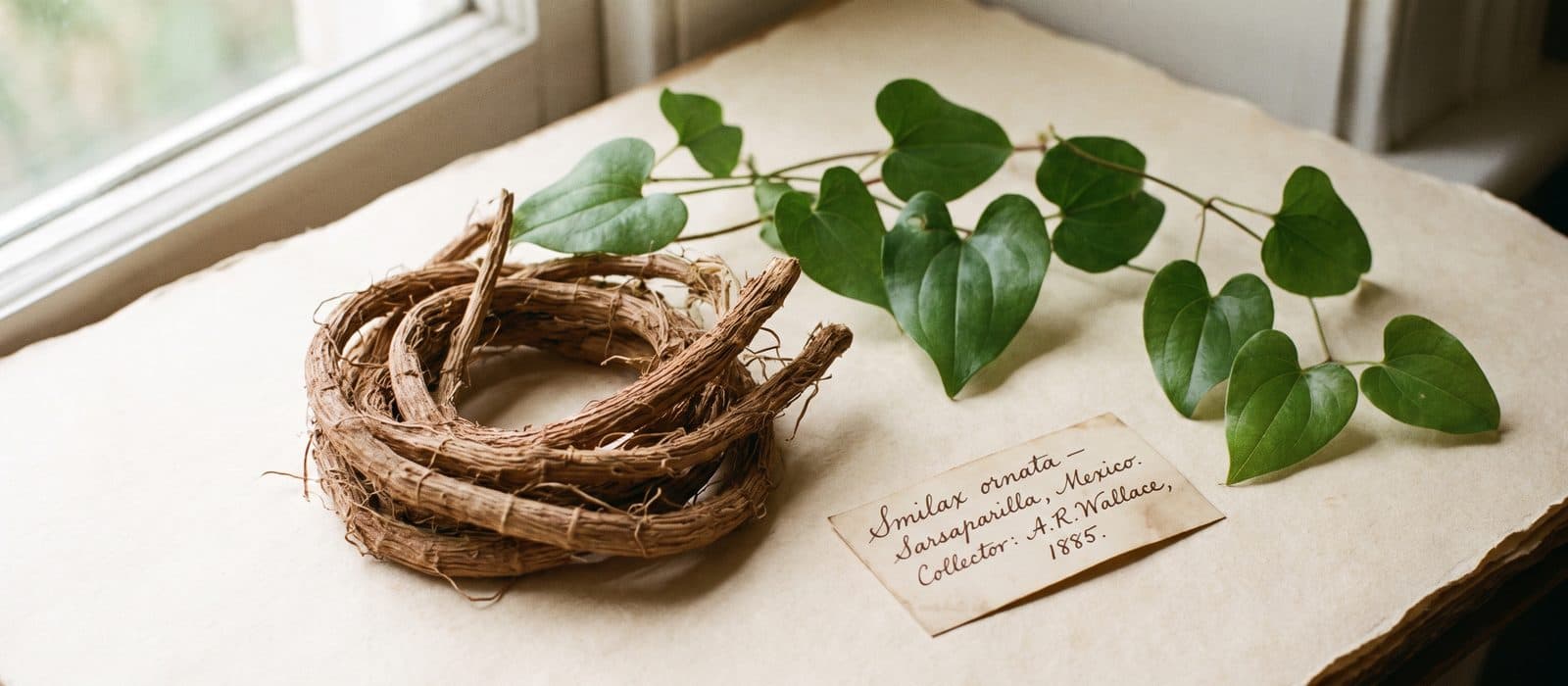
Homeopathic Sarsaparilla is prepared from the dried root of Smilax species, prickly climbing vines of the tropical forests of Central and South America. Pharmacopoeias have named different species over time, chiefly Smilax ornata and Smilax regelii; the trade name sarsaparilla covers them all. The long, slender roots were exported to Europe from the sixteenth century, first as a reputed remedy for syphilis and later as a "blood purifier" and a flavouring.
That history is the main thing to untangle. Sarsaparilla root is not a poison; it was a soft-drink flavouring for generations, and it is still sold as a herbal supplement and tea. Those products contain measurable amounts of the root. Homeopathic Sarsaparilla is something else: a tincture of the root carried through repeated dilution and succussion, so that at the common potencies the arithmetic says no molecule of the root remains. Our potencies guide explains that honestly, including why it is also the reason science is sceptical, and our guide to what is in a homeopathic remedy covers what the pellets themselves contain.
The practical point is about labels. A tub of sarsaparilla capsules and a tube of Sarsaparilla 30C sit in the same shop under the same name, and they are not interchangeable in either direction.
What is the Sarsaparilla picture?
The Sarsaparilla picture is specific to the point of oddness. Classic texts describe someone with an irritable bladder who notices that the burning is not constant: it builds to a peak just as the last of the urine passes, severe enough to make them dread finishing. Boericke (1927) describes the pain at the conclusion of urination as almost unbearable. Sitting on the toilet, the urine only dribbles; standing, it flows. The urine may be scanty, with a sandy or gravelly sediment, sometimes white, and older books describe bladder distension and tenderness.
Around that local picture the materia medica describes a general one. The person is thin, with dry, shrivelled skin that looks older than they are, and the skin lies in folds. Eruptions such as dry, itchy patches and cracks, especially on the hands and feet, come back in spring. Some texts note low spirits and irritability with the pain, the mood of someone worn down by a complaint that returns on every visit to the toilet.
Clarke's Dictionary (1900–1902) and Hering's Guiding Symptoms gather the same urinary details from the provings and from later clinical reports, and both give the end-of-urination timing more weight than any other feature. The skin and general symptoms are recorded too, but in the classic texts they are what confirms the picture, not what starts it.
Most of these details sound minor, and most people would not think to mention them. That is exactly why homeopaths value them: "burning when urinating" is common to many pictures, while "burning at the end, standing to pass water" is not.
What makes it better or worse?
The traditional modalities centre on the act of urinating, posture and the season. Sarsaparilla is worse at the end of urination, at night and in damp weather, and urine passes better when standing.
| Modality | Worse | Better |
|---|---|---|
| Urination | At the close of urination; just after | Before and during the flow |
| Position | Sitting (urine dribbles) | Standing (urine flows freely) |
| Time | Night | Day |
| Weather and season | Damp, cold; spring (skin) | Dry, settled weather |
| Cycle | Before a period (Boericke) | After it begins |
Timing within the act of urinating is a modality like any other; our guide to modalities, better and worse explains why a homeopath asks about it before any remedy name.
What is Sarsaparilla traditionally discussed for?
In homeopathic literature, Sarsaparilla is traditionally discussed for urinary burning with a precise timing, and for some dry-skin complaints. On this site it appears on one acute page, where the pattern sits beside its neighbours and the red flags come first.
Urinary
- Burning urination: the burning-at-the-end pattern, where the pain peaks as the last drops pass and urine flows more easily when standing. Classic texts also discuss gravel and sandy sediment under this heading.
Skin (classic texts)
- Older materia medica describes dry, shrivelled, wrinkled skin, and cracks and dry eruptions on the hands and feet that return each spring. There is no acute page for these here; a rash with fever, or cracked skin that becomes red, hot and spreading, is a medical question first.
What is Sarsaparilla not?
Sarsaparilla is not a remedy for urinary infections, and it is not a substitute for a urine test. Burning on urination is very often a bladder infection, and infections can climb to the kidneys. Fever or chills, pain in the back or side, blood in the urine, nausea or vomiting, symptoms that last more than a couple of days, burning in pregnancy, and any urinary symptoms in a man or a child are reasons for medical assessment first. So is passing gravel or stones with severe, colicky pain. Our red flags first guide sets out why those questions come before any pattern.
It is also not the herbal supplement. Sarsaparilla root capsules and teas are a separate product category with their own label claims, and nothing here refers to them.
Homeopaths separate it from its urinary neighbours like this:
| Picture | Where it sits | Defining feature | Key modality |
|---|---|---|---|
| Sarsaparilla | Burning at the close of urination | Pain peaks at the last drops; sandy sediment; dribbles sitting | Better standing to pass water |
| Cantharis | Violent, constant urging | Cutting, scalding burning before, during and after; passes drop by drop | Worse from cold water and touch |
| Apis mellifica | Stinging irritation with swelling | Stinging burning; scanty urine; thirstless | Worse from heat; better from cold |
| Staphysagria | Burning after catheter or intercourse | Burning felt when not urinating; suppressed indignation | Better while the urine flows |
| Lycopodium | Gravel and slow flow | Red, sandy sediment; must strain; right-sided | Worse 4–8 p.m. |
What potencies is Sarsaparilla sold in?
Sarsaparilla is sold most often as 6C and 30C pellets, usually through homeopathic pharmacies. Potency describes the preparation process, not an amount of root: 30C means thirty successive 1:100 dilutions with succussion between them. Our potencies guide explains the scale and what remains in the vial.
This page deliberately gives no frequency or instructions for taking Sarsaparilla. That depends on a whole case, not a remedy name. Read the product label, and talk to a qualified practitioner about an individual situation.
What remedy lists don't tell you
Two things the "remedies for burning urination" lists leave out:
- When the burning happens is the real sorting question. Before the flow, during it, at the end, or between visits: classic texts give each timing to a different picture. Lists sorted by "cystitis" never ask, and it is one of the first things a homeopath does ask. Our guide to the symptoms alongside the symptom explains how to notice details like this.
- Recurring urinary burning is a medical pattern before it is a homeopathic one. Someone who has the same symptoms several times a year needs to know why, which means tests, not a remedy name. The homeopathic literature on Sarsaparilla was written for describing a case, not for skipping that step.
Where the Sarsaparilla picture appears on this site
Acute pages that discuss this picture among their educational patterns, with the pattern name each page uses.
- What homeopathic remedy for burning urination?Sarsaparilla-like urethral burning at end pattern
Not sure whether a picture fits?
A remedy profile describes a picture; it cannot tell you whether that picture matches what you are seeing. An acute consultation starts from the case itself: onset, sensations, what changes it, and the red flags.
Acute consultation · $45Frequently asked questions
- What is Sarsaparilla?
- Sarsaparilla is a homeopathic remedy prepared from the dried root of tropical American Smilax vines, the same root once used to flavour sarsaparilla soft drinks. In homeopathy it names a traditional picture: urinary burning that is worst at the very end of passing water, sometimes with the odd detail that urine flows freely only when standing. It is a description homeopaths use to compare cases, not a finding that it works for any condition.
- What is Sarsaparilla used for in homeopathy?
- Homeopathic literature traditionally discusses Sarsaparilla for urinary discomfort with a particular shape: severe burning at the close of urination, sediment or gravel in the urine, and dribbling when sitting. Classic texts also describe dry, shrivelled skin and eruptions that come in spring. Fever, back or side pain, blood in the urine, pregnancy, or urinary symptoms in a man or a child need medical care first.
- What is Sarsaparilla 30C used for?
- 30C is a commonly sold potency of Sarsaparilla, along with 6C, though it is mostly found through homeopathic pharmacies rather than general shops. In the tradition the potency does not change the picture; 30C is discussed for the same burning-at-the-end urinary state as any other potency. Our potencies guide explains what 30C means as a dilution.
- How is Sarsaparilla taken?
- This page does not give instructions on how or how often to take any remedy, because that depends on a whole case rather than on a remedy name. The product label carries the manufacturer's directions, and a qualified practitioner can advise on an individual situation. Urinary symptoms with fever, back pain or blood belong with a clinician first.
- Where can I buy Sarsaparilla?
- Homeopathic pharmacies and manufacturers sell Sarsaparilla as single-remedy pellets, most often in 6C and 30C. Herbal sarsaparilla root sold as a supplement or tea is a different product. This site also prepares custom single remedies to order: you name the remedy and potency, and the details are confirmed by email before anything is made. The order form does not give advice on which remedy to choose.
- What is Sarsaparilla made from?
- Homeopathic Sarsaparilla is prepared from the dried root of Smilax species, climbing, prickly vines of Central and South America. The root is extracted into a tincture, then diluted and succussed step by step to the labelled potency. The root is not a poison; it has a long history as a flavouring and a herbal tonic, which is part of why the homeopathic preparation is easily confused with the herbal one.
This guide is educational only and is not medical advice or a personalized remedy recommendation. Acute symptoms can become urgent; when in doubt, seek professional evaluation.