Remedy profile
Plantago major in Homeopathy: Uses, Picture and Limits
What homeopathic Plantago major is made from, the aching tooth-nerve picture homeopaths describe, what changes it, potencies sold, and its limits.
By Homeopathic BenefitsPublished 7 min read
Key takeaways
- Plantago is the picture of the aching tooth nerve. Classic texts describe sensitive, aching teeth with pain that radiates into the cheek, the face and the ear.
- Saliva and soreness go with it. The old descriptions include a flow of saliva and teeth that feel too long or sore to touch.
- It comes from a common weed. Greater plantain grows on paths and lawns almost everywhere; it is not psyllium, which comes from a related species.
- It is thinly documented. Plantago is a small remedy with one clear strand; the honest picture is short.
- Toothache is a dental question first. Facial or jaw swelling, fever, pus, a bad taste, difficulty swallowing or breathing, or pain lasting more than a day or two needs a dentist or doctor.
The short answer
Plantago major is a homeopathic remedy prepared from greater plantain, the flat-leaved weed that grows in lawns, paths and field edges almost everywhere. In homeopathy it names a traditional picture rather than a treatment: aching, sensitive teeth and nerve-like pain that radiates from a tooth into the cheek, face and ear, often with a flow of saliva. Classic materia medica gives it a modest reputation for toothache and earache and records a few other strands, including a historical association with an aversion to tobacco. It came into homeopathy through nineteenth-century American practice and is thinly documented compared with the major remedies. It is not a toothache remedy in any sense that replaces a dentist, and swelling, fever or lasting pain needs dental care first.
| Latin name | Plantago major |
|---|---|
| Abbreviation | Plan. |
| Common name | Greater plantain, broadleaf plantain, waybread |
| Source | Fresh whole plant of greater plantain, Plantago major (Plantaginaceae) (plant kingdom) |
| Commonly sold potencies | Mother tincture, 6C, 30C |
| First proving | Proved in nineteenth-century American homeopathy; recorded in Hale's New Remedies and Allen's Encyclopedia (1874–1879) |
What is Plantago major made from?
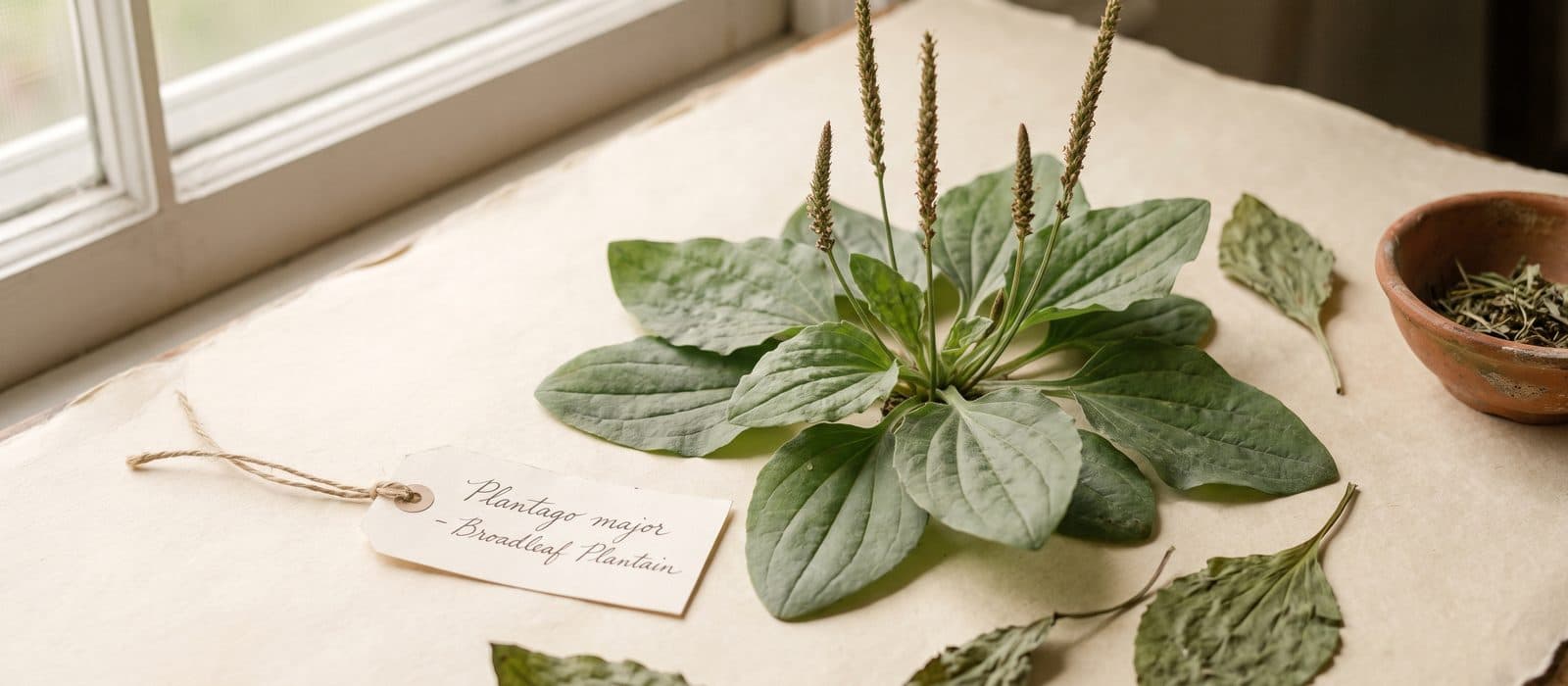
Homeopathic Plantago is prepared from the fresh whole plant of greater plantain, Plantago major, a low perennial of the plantain family (Plantaginaceae). It is one of the most widespread plants on earth: a rosette of broad, oval, ribbed leaves pressed flat against the ground, sending up thin spikes of tiny brownish-green flowers. It thrives where the ground is trodden, which is why it lines footpaths and gateways. The old English name waybread means "way-leaf", and early colonists carried it so widely across North America that some Indigenous peoples called it white man's footprint.
It is not the banana-like cooking plantain, which is a different plant entirely, and it is not psyllium. Psyllium husk, sold as a fibre supplement, comes from the seeds of a related species, Plantago ovata. The shared name causes confusion that our guide to reading Latin remedy names is meant to clear up: the full Latin name is the thing to read.
Greater plantain has a long folk history as a poultice plant for stings and minor scrapes, and its young leaves are eaten as a wild green. The plant is not poisonous. For the homeopathic preparation, the fresh plant is steeped in alcohol to make a mother tincture, which is then diluted and succussed step by step to the potency on the label. At 30C the arithmetic says no molecule of the plant remains; our potencies guide explains what that means and why it is also the reason science is sceptical.
What is the Plantago picture?
The Plantago picture is pain that starts in a tooth and does not stay there. Imagine someone with an aching molar: the tooth feels sore, slightly too long and tender when the teeth meet, and the ache runs along the jaw into the cheek and up towards the ear on the same side. The mouth fills with saliva. It is a nagging, nervy ache rather than the throbbing of an abscess or the screaming pain that makes someone frantic.
Classic texts build the remedy around this strand. Boericke (1927) notes that Plantago has a considerable clinical reputation for earache and toothache, and describes teeth that are sore and sensitive to touch, with pain that radiates to the ear, and a profuse flow of saliva. The nineteenth-century American sources that first recorded it, collected in Hale's New Remedies and in Allen, describe similar radiating facial pain.
Beyond the teeth, the materia medica records a handful of other features: earache with pain passing from one ear to the other through the head, a tendency to pass a lot of urine, and an aversion to tobacco, which led some nineteenth-century authors to mention it in connection with giving up smoking. These are scattered notes rather than a full constitutional picture. Plantago has no detailed mental-emotional description in the classic texts, and an honest profile says so rather than inventing one.
What makes it better or worse?
Plantago's modalities are sparse in the classic texts, which is typical of a small remedy known mainly for one strand. What is recorded centres on contact and on the radiating quality of the pain.
| Modality | Worse | Better |
|---|---|---|
| Contact | Touching the tooth; biting down | Leaving the tooth alone |
| Temperature | Cold air and cold drinks on the sensitive tooth | No consistent keynote |
| Eating | No consistent keynote | Some texts record the ache easing while eating |
| Spread | Pain radiating from tooth to cheek and ear | No clear keynote |
The thinness of these modalities is itself useful: a homeopath reading a toothache with strong, clear modalities, such as pain that is unbearable from warmth or eased only by cold water, will usually be reading a different picture. Our guide to modalities, better and worse explains how that comparison works.
What is Plantago traditionally discussed for?
In homeopathic literature, Plantago is traditionally discussed for aching, sensitive teeth with pain that radiates into the face and ear. On this site it appears on two acute pages, where the Plantago-like pattern sits beside its neighbours and the red flags come first.
Teeth
- Localised dental sensitivity with radiating facial sensations: teeth sensitive to cold. That page sets the Plantago-like pattern beside the warmth-eased Magnesia phosphorica-like and the shooting Hypericum-like pictures.
- Localised tooth-nerve pain with cheek numbness sensations: a sudden toothache flare, where it sits beside the unbearable, irritable Chamomilla-like picture.
Ears
- The classic texts also describe earache with pain passing through the head. Our page on mild earache during an illness covers other pictures and the red flags for ears, including discharge, high fever and swelling behind the ear.
What is Plantago not?
Plantago is not "the toothache remedy", and it is no substitute for a dentist. Toothache almost always has a cause a dentist can find, such as decay, a cracked tooth, a failing filling, gum disease, exposed root surfaces or an infection at the root, and most of those get worse without dental care. Teeth that are newly sensitive to cold are a reason for a dental check, not only for reading a picture. Facial or jaw swelling, fever, pus or a foul taste, pain that wakes someone at night, swelling under the tongue or jaw, or any difficulty swallowing or breathing needs urgent dental or medical care, because dental infections can spread. Our guide to red flags first sets out the principle.
Within the tradition, Plantago is the nagging, radiating, nerve-like toothache with saliva. Homeopaths separate it from its neighbours like this:
| Picture | Where it sits | Defining feature | Key modality |
|---|---|---|---|
| Plantago major | Aching tooth-nerve pain | Sore, sensitive tooth; pain radiates to cheek and ear; saliva | Worse touch; few strong modalities |
| Chamomilla | Unbearable dental and teething pain | Pain out of proportion; frantic, angry, inconsolable | Worse warm food and at night |
| Magnesia phosphorica | Sharp, shooting neuralgic zings | Lightning-like pains that come and go | Better heat and pressure; worse cold |
| Coffea cruda | Toothache with an overexcited nervous system | Pain intolerable, senses heightened, sleepless | Better holding cold water in the mouth |
What potencies is Plantago major sold in?
Plantago major is sold mainly as a mother tincture and as pellets in low potencies such as 6C, with 30C available from some homeopathic manufacturers but not a common shelf potency. It is a specialist remedy rather than a kit remedy. Potency describes the preparation process, not an amount of plant: 30C means thirty successive 1:100 dilutions with succussion between them, while a mother tincture is the undiluted alcoholic extract. Our potencies guide explains the scale and what remains in each.
This page deliberately gives no frequency or instructions for taking or applying Plantago major. That depends on a whole case, not a remedy name. Read the product label, and talk to a qualified practitioner about an individual situation.
What remedy lists don't tell you
Two things the "remedies for toothache" lists leave out:
- A toothache is a symptom with a cause, and the cause belongs to a dentist. Lists of toothache remedies can leave the impression that the pain is the problem. In almost every case the problem is in the tooth or the gum, and what changes the outcome is finding it. A homeopath reading a dental case asks when the person last saw a dentist before asking anything about saliva or radiation.
- A small remedy is still worth describing precisely. Plantago has one clear strand and a few scattered notes, and lists either inflate it into a general "nerve pain remedy" or drop it entirely. The tradition's actual description is narrower and more useful: the aching, too-long, touch-sensitive tooth whose pain runs into the ear. Our guide to the symptoms alongside the symptom explains why that kind of companion detail is what separates one picture from another.
Where the Plantago major picture appears on this site
Acute pages that discuss this picture among their educational patterns, with the pattern name each page uses.
- What homeopathic remedy for a sudden toothache flare?Plantago major-like tooth nerve focus pattern
- What homeopathic remedy for teeth sensitive to cold?Plantago-like tooth-nerve sensitivity pattern
Not sure whether a picture fits?
A remedy profile describes a picture; it cannot tell you whether that picture matches what you are seeing. An acute consultation starts from the case itself: onset, sensations, what changes it, and the red flags.
Acute consultation · $45Frequently asked questions
- What is Plantago major?
- Plantago major is a homeopathic remedy prepared from greater plantain, the flat-leaved weed of lawns, paths and field edges across the world. In homeopathy it names a traditional picture centred on the nerves of the teeth and face: aching, sensitive teeth with pain that radiates into the cheek and ear, often with a flow of saliva. It is a description homeopaths use to compare cases, not a finding that it works for toothache or any other condition.
- What is Plantago used for in homeopathy?
- Homeopathic literature traditionally discusses Plantago for toothache and sensitive teeth, especially aching that radiates from the tooth into the face and ear, and for some earache pictures. The picture is defined by the radiating, nerve-like quality of the pain, not by the name of a complaint. Facial or jaw swelling, fever, pus, or difficulty swallowing or breathing with a toothache needs a dentist or doctor urgently.
- What is Plantago major 30C used for?
- 30C is available for Plantago major, but it is not one of the common shelf potencies; the remedy is sold more often as a mother tincture or in low potencies such as 6C. In the tradition the potency does not change the picture; Plantago 30C is discussed for the same radiating tooth-nerve state as any other potency. What 30C means as a dilution is explained in our potencies guide.
- How is Plantago major taken?
- This page does not give instructions on how or how often to take or apply any remedy, because that depends on a whole case rather than on a remedy name. The product label carries the manufacturer's directions, and a qualified practitioner can advise on an individual situation. A toothache that lasts more than a day or two needs a dentist, whatever else is done.
- Where can I buy Plantago major?
- Plantago major is a specialist remedy, sold mainly by homeopathic manufacturers and homeopathic pharmacies as a mother tincture or as pellets in low potencies, with 30C less common. This site also prepares custom single remedies to order: you name the remedy and potency, and the details are confirmed by email before anything is made. The order form does not give advice on which remedy to choose.
- What is Plantago major made from?
- Homeopathic Plantago is prepared from the fresh whole plant of greater plantain, Plantago major, steeped into a mother tincture and then diluted and succussed step by step to the labelled potency. It is not the same plant as psyllium, which comes from the seed husks of a related species, Plantago ovata, and is sold as a fibre supplement.
This guide is educational only and is not medical advice or a personalized remedy recommendation. Acute symptoms can become urgent; when in doubt, seek professional evaluation.