Remedy profile
Robinia pseudacacia in Homeopathy: Uses, Picture and Limits
What homeopathic Robinia is made from, the intensely sour, night-time reflux picture homeopaths describe, what changes it, the potencies sold, and its limits.
By Homeopathic BenefitsPublished 7 min read
Key takeaways
- Robinia is the picture of intense sourness. Classic texts describe sour belching, sour vomiting and acid regurgitation so marked that the teeth feel set on edge.
- Night and lying down make it worse. The acid surges up after going to bed, often after a late or heavy meal, and the person has to sit up.
- Burning and a frontal headache can ride along. The materia medica describes burning in the stomach and between the shoulder blades, with a dull headache over the forehead during the acidity.
- It comes from black locust bark. The raw bark is poisonous; potentised preparations are diluted far past the point where the bark is a concern.
- Reflux has red flags. Chest pain, difficulty or pain swallowing, vomiting blood, black stools, weight loss, or reflux that persists for weeks needs medical assessment first.
The short answer
Robinia pseudacacia is a homeopathic remedy prepared from the bark of the black locust tree, a North American tree of the pea family now common in European parks and hedges. In homeopathy it names a traditional picture rather than a treatment: intense acidity, with sour belching, sour regurgitation and burning in the stomach that surge up at night on lying down, sometimes with a dull frontal headache. It is a small, thinly documented remedy with one clear keynote, described in Clarke's Dictionary (1900–1902) and Boericke (1927), where the sourness is the whole point. It is not a substitute for medical assessment of persistent reflux, and chest pain is never something to put down to acid without a clinician's view.
| Latin name | Robinia pseudacacia |
|---|---|
| Abbreviation | Rob. |
| Common name | Black locust, false acacia (yellow locust in older texts) |
| Source | Bark of the young twigs of the black locust tree, Robinia pseudacacia (Fabaceae) (plant kingdom) |
| Commonly sold potencies | 6C, 30C |
| First proving | Nineteenth-century American provings; recorded in Clarke's Dictionary (1900–1902) and Boericke (1927) |
What is Robinia made from?
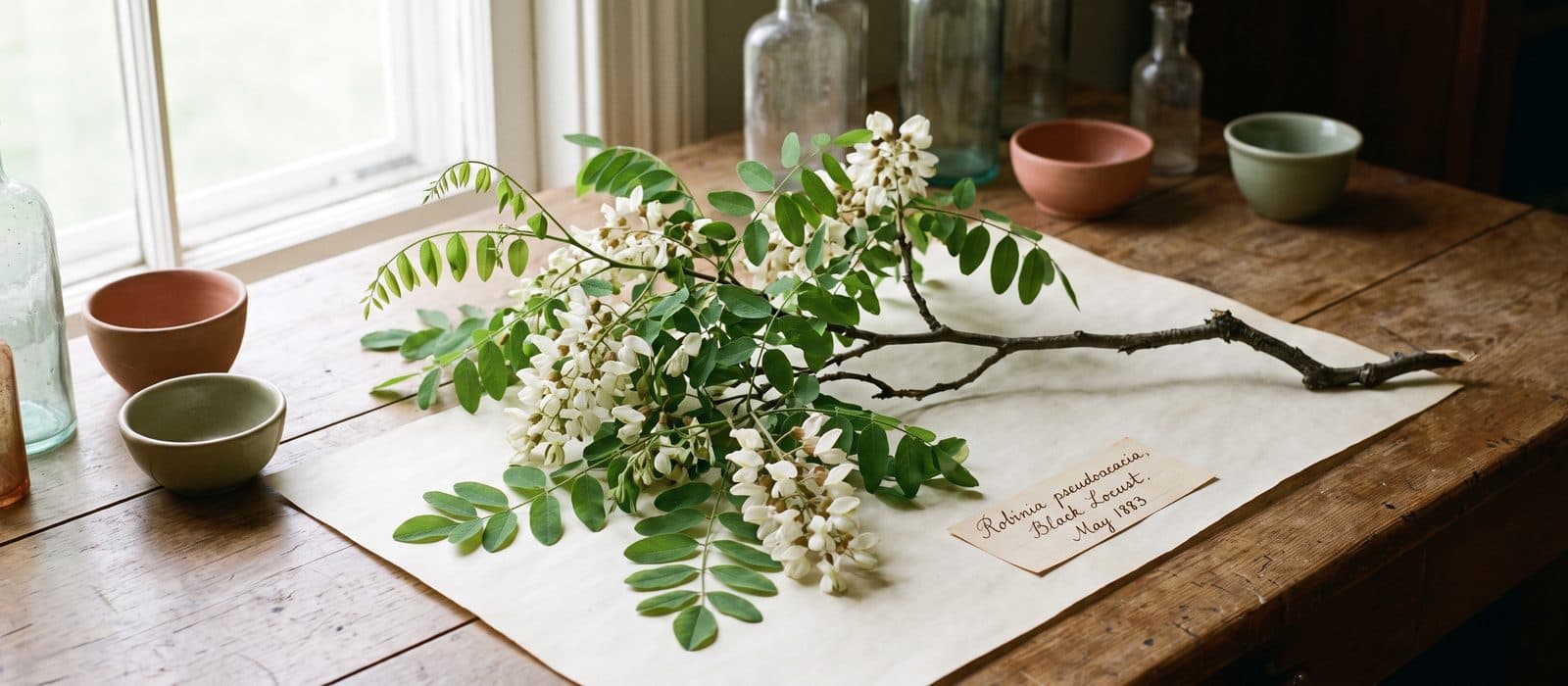
Homeopathic Robinia is prepared from the bark of the young twigs of Robinia pseudacacia, the black locust or false acacia. It is a fast-growing tree of the pea family (Fabaceae), native to the eastern United States and planted across Europe since the seventeenth century for its hard, rot-resistant timber and its hanging clusters of scented white flowers. The branches carry pairs of sharp spines, and the leaves are divided into small oval leaflets, which is why it was taken for an acacia. The species name pseudacacia means exactly that: false acacia. Older homeopathic texts sometimes call it yellow locust. Our guide to reading Latin remedy names explains why the Latin name is what reaches the label.
The source deserves plain words. The bark, seeds and leaves of black locust contain toxic proteins, and both children who chewed the bark or seeds and horses that stripped the trees have been poisoned, with vomiting, abdominal pain and weakness. The flowers are eaten in some places; the bark is not food. The raw bark is never something to chew, brew or prepare at home. The homeopathic preparation makes a mother tincture of the bark and carries it through repeated dilution and succussion; at the common potencies the arithmetic says no molecule of the bark remains. Our potencies guide explains what that means and why it is also the reason mainstream science is sceptical.
What is the Robinia picture?
The Robinia picture is the person sitting up in bed at midnight with a mouth full of acid. They ate late, perhaps something spicy or rich, went to bed, and within an hour felt the burning climb. Now sour fluid rises into the throat, so sour that it seems to strip the enamel from the teeth, and every belch tastes of vinegar. Lying flat brings it up again; propped up on pillows they can just about doze. There may be a dull, heavy ache across the forehead, and a burning that seems to sit between the shoulder blades as well as under the breastbone.
Classic texts describe intense acidity as the defining feature: sour eructations, sour vomiting, and acid regurgitation so marked that the whole complaint seems to revolve around it. Boericke (1927) describes the acidity as worse at night and on lying down, with a frontal headache, a distended, flatulent stomach and, in children, sour-smelling stools, so that the whole child seems to smell sour. The older texts noted that the acid could come up even with very little food in the stomach.
Because it is thinly documented, the Robinia picture has little of the temperament that fills out larger remedies. That is part of the honesty of the page: the materia medica records a person largely defined by one striking sensation. Homeopaths read that sensation carefully, and they also expect it to sit beside other companions, such as the mood, the thirst and the effect of food, which come from the individual case rather than from the book.
What makes it better or worse?
The traditional modalities centre on night and posture. Robinia is worse at night, on lying down and after rich or late meals, and better sitting upright.
| Modality | Worse | Better |
|---|---|---|
| Time | Night, soon after going to bed | Daytime |
| Position | Lying flat | Sitting up, head raised |
| Food | Late meals, rich or spicy food, fats; raw fruit in some texts | No consistent keynote |
| Sensation | Sour belching, acid regurgitation | Belching may ease the distension briefly |
| Temperature | No consistent keynote | No consistent keynote |
Night and lying down are the modalities that matter most here; our guide to modalities, better and worse explains why position and time can separate pictures that look alike by day.
What is Robinia traditionally discussed for?
In homeopathic literature, Robinia is traditionally discussed for intensely sour, night-worse acidity. Each of these appears on one of our acute pages, where the Robinia-like pattern sits beside its neighbours and the red flags come first.
Acid and reflux
- Acid reflux after spicy food, where sour regurgitation surges at night after a late, spicy dinner.
- Heartburn after a large meal, where the burning is intensely sour and worse lying down.
Our guide to hangovers, rich food and bad food covers the wider territory of after-meal complaints and how homeopaths read the reaction before naming anything.
What is Robinia not?
Robinia is not "the acid reflux remedy", and the presence of acid does not settle what is going on. Chest pain is the first thing to rule out: pain, pressure or tightness in the chest, especially spreading to the arm, jaw or back, or with breathlessness or sweating, is an emergency until a clinician says otherwise, however much it feels like indigestion. Difficulty or pain swallowing, food sticking, vomiting blood or material like coffee grounds, black or tarry stools, unexplained weight loss, a persistent cough or hoarseness with reflux, or reflux that has gone on for weeks or is getting worse, especially after the age of fifty-five, all need medical assessment first. In pregnancy and in babies, reflux deserves a midwife's or doctor's view. Our guide to red flags first explains the order.
Homeopaths separate it from its neighbours like this:
| Picture | Where it sits | Defining feature | Key modality |
|---|---|---|---|
| Robinia pseudacacia | Night-time acid reflux | Intensely sour belching and regurgitation; frontal headache | Worse at night and lying down |
| Nux vomica | Excess, overwork, stimulants | Irritable, chilly; retching without result | Worse morning and after excess |
| Carbo vegetabilis | Upper-abdominal gas | Sluggish, bloated, faint; wants air | Better belching and being fanned |
| Pulsatilla | Rich, fatty food | Heavy, changeable, thirstless; wants company | Better open air; worse warm rooms |
| Argentum nitricum | Anxious, gassy stomach | Loud belching, craving sweets that disagree | Worse sweets and anticipation |
What potencies is Robinia sold in?
Robinia pseudacacia is a less common remedy, sold mainly through specialist homeopathic pharmacies, usually as 6C or 30C pellets and sometimes made to order. Potency describes the preparation process, not an amount of bark: 30C means thirty successive 1:100 dilutions with succussion between them. Our potencies guide explains the scale and what remains in the vial.
This page deliberately gives no frequency or instructions for taking Robinia. That depends on a whole case, not a remedy name. Read the product label, and talk to a qualified practitioner about an individual situation.
What remedy lists don't tell you
Two things the "remedies for heartburn" lists leave out:
- How sour it is matters more than how much it burns. Heartburn can be burning, gassy, heavy, bitter or sour, and homeopaths read those as different descriptions. Robinia sits at the far sour end, where the acid seems to set the teeth on edge. A list that files every kind under "heartburn" throws away the one word that separates it from its neighbours. Our guide to the symptoms alongside the symptom shows how to record the quality as well as the place.
- A small remedy is still a whole case. Thin remedies like Robinia are tempting because they seem to have a single, simple keynote. A homeopath still asks about everything around that keynote: when it started, what was eaten, the mood, the thirst, the sleep. One striking sensation narrows the search; it does not end it.
Where the Robinia pseudacacia picture appears on this site
Acute pages that discuss this picture among their educational patterns, with the pattern name each page uses.
- What homeopathic remedy for acid reflux after spicy food?Robinia-like nighttime sour-surge pattern
- What homeopathic remedy for heartburn after a large meal?Robinia-like sour, burning upward pattern
Not sure whether a picture fits?
A remedy profile describes a picture; it cannot tell you whether that picture matches what you are seeing. An acute consultation starts from the case itself: onset, sensations, what changes it, and the red flags.
Acute consultation · $45Frequently asked questions
- What is Robinia pseudacacia?
- Robinia pseudacacia is a homeopathic remedy prepared from the bark of the black locust tree, a North American tree now planted widely in Europe. In homeopathy it names a traditional picture of intense acidity: sour belching and sour regurgitation, burning in the stomach, and a marked aggravation at night on lying down, sometimes with a frontal headache. It is a description homeopaths use to compare cases, not a finding that it works for reflux or any other condition.
- What is Robinia used for in homeopathy?
- Homeopathic literature traditionally discusses Robinia for intensely sour reflux: acid that surges up at night, sour enough to set the teeth on edge, after late or spicy meals, with burning in the stomach and between the shoulder blades. The picture is defined by the extreme sourness and the night-time, lying-down aggravation, not by the name of the complaint. Chest pain, difficulty swallowing, vomiting blood, black stools or unexplained weight loss need medical care first.
- What is Robinia 30C used for?
- Robinia is a less common remedy, and 30C is not always stocked; homeopathic pharmacies usually supply it in 6C or 30C, sometimes to order. In the tradition the potency does not change the picture; Robinia 30C is discussed for the same intensely sour, night-time reflux as any other potency. What 30C means as a dilution is explained in our potencies guide.
- How is Robinia taken?
- This page does not give instructions on how or how often to take any remedy, because that depends on a whole case rather than on a remedy name. The product label carries the manufacturer's directions, and a qualified practitioner can advise on an individual situation. Reflux that is frequent, persistent or getting worse belongs with a clinician first.
- Where can I buy Robinia?
- Specialist homeopathic pharmacies and manufacturers sell Robinia pseudacacia as single-remedy pellets, usually in 6C or 30C; it is rarely on general shop shelves or in home kits. This site also prepares custom single remedies to order: you name the remedy and potency, and the details are confirmed by email before anything is made. The order form does not give advice on which remedy to choose.
- What is Robinia made from?
- Homeopathic Robinia is prepared from the bark of the young twigs of the black locust tree, Robinia pseudacacia, made into a mother tincture and then diluted and succussed step by step to the labelled potency. The bark, seeds and leaves of the tree contain toxic proteins and have poisoned people and livestock, so the raw bark is never something to chew, brew or prepare at home. It appears on labels only in potentised form.
This guide is educational only and is not medical advice or a personalized remedy recommendation. Acute symptoms can become urgent; when in doubt, seek professional evaluation.