Remedy profile
Spigelia anthelmia in Homeopathy: Uses, Picture and Limits
What homeopathic Spigelia is made from, the stitching, left-sided eye-pain picture homeopaths describe, what changes it, potencies sold, and its limits.
By Homeopathic BenefitsPublished 7 min read
Key takeaways
- Spigelia is the picture of stitching, left-sided pain. Classic texts describe sharp, radiating neuralgia above and behind the left eye, spreading over the left side of the head and face.
- Touch and motion are unbearable. The person keeps very still, because moving the eyes, the head or the body sharpens the pain.
- The pain follows the sun. The older literature describes a headache that starts in the morning, peaks around midday and fades towards evening.
- It comes from a poisonous tropical herb. Pinkroot is a relative of the strychnine tree; potentised preparations are diluted far past the point where the plant remains.
- Its territory is a red-flag territory. A sudden or "worst ever" headache, a painful red eye with blurred vision or haloes, and any chest pain or palpitations with faintness or breathlessness are emergencies first.
The short answer
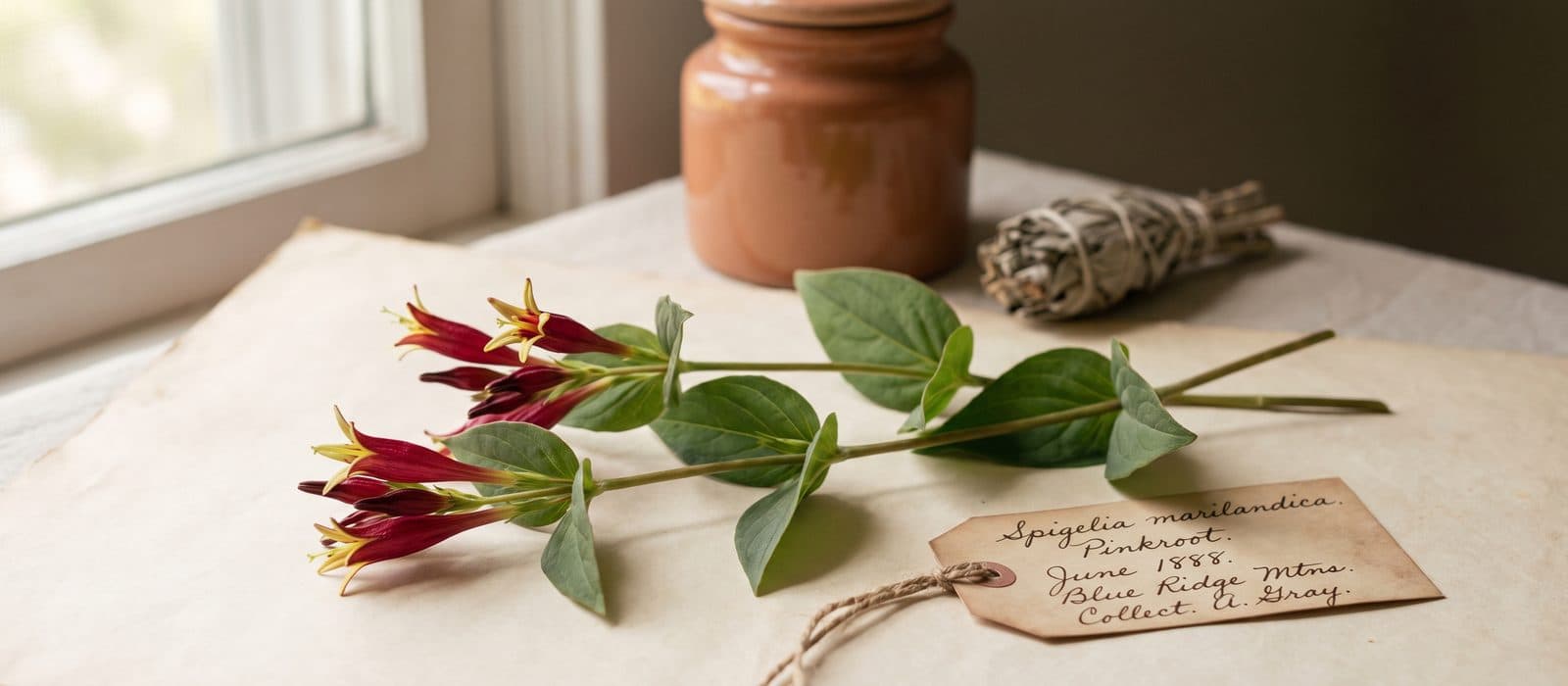
Spigelia is a homeopathic remedy prepared from Spigelia anthelmia, known as pinkroot or worm grass, a small poisonous herb of the Caribbean and tropical South America once given as a worm medicine. In homeopathy it names a traditional picture rather than a treatment: sharp, stitching, radiating pain, mostly on the left side, above all a neuralgia above and behind the left eye that is exquisitely sensitive to touch, jarring and motion. Classic materia medica adds pains that rise and fall with the sun, eyeballs that feel too large, and palpitations with stitching pains in the chest. Hahnemann proved it and published it in his Materia Medica Pura. It is not a migraine or cluster headache remedy, and new or severe head, eye or chest pain needs medical care first.
| Latin name | Spigelia anthelmia |
|---|---|
| Abbreviation | Spig. |
| Common name | Pinkroot, Demerara pinkroot, worm grass |
| Source | Dried whole plant of Spigelia anthelmia, a tropical American herb (Loganiaceae) (plant kingdom) |
| Commonly sold potencies | 6C, 30C, 200C |
| First proving | Hahnemann, Materia Medica Pura (1811–1821) |
What is Spigelia made from?
Homeopathic Spigelia is prepared from the dried whole plant of Spigelia anthelmia, an annual herb of the West Indies, Central America and tropical South America, often found as a weed of fields and roadsides. It grows to knee height with whorls of pointed leaves at the top of the stem and slender spikes of small pinkish-white flowers. Its species name, anthelmia, means "against worms", and for centuries the plant was used in the Caribbean and South America to expel intestinal worms; Demerara pinkroot was traded under that name. Our guide to reading Latin remedy names explains why old names like this stay on labels.
The source deserves an honest note. Spigelia belongs to the Loganiaceae, the same family as the strychnine tree that gives Nux vomica, and the raw plant is poisonous; even as a worm medicine it was regarded as a risky herb that affected the nervous system and the heart. It is never something to prepare or use at home. The homeopathic preparation makes a tincture of the dried plant and carries it through repeated dilution and succussion to the labelled potency. At the common potencies the arithmetic says no molecule of the plant remains. Our potencies guide explains what that means, and why it is also the reason science is sceptical.
What is the Spigelia picture?
The Spigelia picture is pain like a hot needle. Imagine someone who woke feeling ordinary, and by mid-morning has a stitching, burning pain fixed above and behind the left eye. It shoots into the eyeball, the temple and the cheek, and seems to pulse outward from one point. By noon it is at its worst. They sit bolt upright and perfectly still, because turning the eyes, moving the head, a footstep on the floor or the touch of a hand sharpens it. As the afternoon wears on, it fades, and by evening it has largely gone.
Boericke (1927) describes Spigelia as a remedy of neuralgia, especially of the left side, with pain that rises and declines with the sun and is worse from touch, motion, noise and jarring. He describes the eyeballs as feeling too large and painful on turning them, and pain deep in the orbit. The face is part of the same picture, with tearing, stitching pain along the left cheekbone and jaw.
The chest is the other half of the classic material. Hahnemann's provers recorded violent palpitations, visible or audible, and stitching pains around the heart, worse from movement and from bending forward. The older texts discuss this cardiac picture at length, but in modern terms these are emergency symptoms rather than remedy material, and this page handles them that way.
There is a small, odd mental keynote the literature repeats: a dread of sharp, pointed things such as pins and needles. Homeopaths value it because it fits the character of the pain itself.
What makes it better or worse?
The traditional modalities centre on touch and movement. Spigelia is worse from the slightest touch, from jarring and motion, and from the rising sun, and better lying still with the head raised.
| Modality | Worse | Better |
|---|---|---|
| Touch and jar | Slightest touch, jarring, a footstep, noise | Keeping perfectly still |
| Motion | Moving the eyes or head, stooping, bending forward | Rest |
| Time | Morning, building to a peak around midday | Evening, as the sun goes down |
| Position | Lying on the left side | Lying on the right side with the head high (Boericke) |
| Side and weather | Left side; cold, damp, stormy weather; tobacco smoke | No consistent keynote |
The side and the sun pattern are the modalities homeopaths weigh most; our guide to modalities, better and worse explains how they are read.
What is Spigelia traditionally discussed for?
In homeopathic literature, Spigelia is traditionally discussed for stitching, radiating, left-sided neuralgia. One of our acute pages carries the Spigelia-like pattern beside its neighbours, with the red flags first.
Head and eye
- Stitching, radiating pain above and behind the left eye, exquisitely sensitive to touch and motion: sudden one-sided head pain around the eye. A new, severe or "worst ever" headache is a medical emergency, and that page sets out the red flags before anything else.
Nearby pages that discuss other pictures
- An eye-strain headache and sinus headache with pressure describe head pain around the eyes where homeopaths compare other pictures; the classic texts reserve Spigelia for pain that is sharp, stitching and one-sided rather than dull and pressing.
What is Spigelia not?
Spigelia is not "the migraine remedy" or "the cluster headache remedy", and the head and eye are a place where a remedy picture must never come before a diagnosis. A sudden, severe headache that peaks within a minute or so, a "worst ever" headache, headache with fever and a stiff neck, confusion, weakness, slurred speech or changed vision, or a headache after a head injury needs emergency care. A painful red eye with blurred vision, haloes around lights, nausea or a fixed pupil may be acute glaucoma and needs same-day emergency eye care. Pain in the chest, palpitations with faintness or breathlessness, or chest pain spreading to the arm or jaw is an emergency, whatever the old cardiac material says. Our guide to red flags first sets these out.
Homeopaths separate it from its neighbours like this:
| Picture | Where it sits | Defining feature | Key modality |
|---|---|---|---|
| Spigelia | Left-sided neuralgia around the eye and face | Stitching, radiating, needle-like pain; eyeballs feel too large | Worse touch and motion; follows the sun |
| Sanguinaria | Right-sided headache | Pain from the back of the head settling over the right eye | Better lying in the dark and sleeping; follows the sun |
| Belladonna | Sudden, hot, throbbing head pain | Throbbing rather than stitching; flushed face, wide pupils | Worse jar, light and noise; better semi-upright |
| Kali bichromicum | Sinus pain at the root of the nose | Pain in small spots that can be covered with a fingertip | Worse cold, stooping; better warmth |
| Cimicifuga | Head and neck pain with muscular tension | Pain shooting up into the head; gloomy, restless | Worse cold and damp; better warmth |
The traditional distinction with Sanguinaria is the side: both are described as sun headaches, but Spigelia settles over the left eye and Sanguinaria over the right.
What potencies is Spigelia sold in?
Spigelia is sold most often as 30C pellets, with 6C and 200C available from homeopathic pharmacies. It is a less common shelf remedy than the polychrests and is more often ordered than picked up in a shop. Potency describes the preparation process, not an amount of plant: 30C means thirty successive 1:100 dilutions with succussion between them. Our potencies guide explains the scale and what remains in the vial, and why low-potency products of toxic sources carry their own labelling.
This page deliberately gives no frequency or instructions for taking Spigelia. That depends on a whole case, not a remedy name. Read the product label, and talk to a qualified practitioner about an individual situation.
What remedy lists don't tell you
Two things the "remedies for headaches" lists leave out:
- Side and timing carry the picture. A list gives Spigelia for headache, which is almost every headache. The classic authors described something narrow: left-sided, stitching, needle-like, building with the morning sun and fading by evening, and unbearable to touch or movement. The companion details, such as the eyeballs feeling too big or a dread of pins, are what the tradition used to confirm it; our guide to the symptoms alongside the symptom explains why companions matter.
- The old cardiac pages belong to history. Nineteenth-century texts discuss Spigelia's heart symptoms at length, from a time before ECGs and emergency cardiology. Chest pain and palpitations are now questions for a clinic, and a modern reading of Spigelia keeps them there.
Where the Spigelia anthelmia picture appears on this site
Acute pages that discuss this picture among their educational patterns, with the pattern name each page uses.
- What homeopathic remedy for a sudden one-sided head pain around the eye?Spigelia-like left-orbital neuralgic pattern
Not sure whether a picture fits?
A remedy profile describes a picture; it cannot tell you whether that picture matches what you are seeing. An acute consultation starts from the case itself: onset, sensations, what changes it, and the red flags.
Acute consultation · $45Frequently asked questions
- What is Spigelia?
- Spigelia is a homeopathic remedy prepared from Spigelia anthelmia, a small poisonous herb of the Caribbean and tropical Americas once used as a worm medicine. In homeopathy it names a traditional picture of stitching, radiating, left-sided pain, above all a neuralgia above and behind the left eye that is exquisitely sensitive to touch and motion. It is a description homeopaths use to compare cases, not a finding that it works for headaches or any other condition.
- What is Spigelia used for in homeopathy?
- Homeopathic literature traditionally discusses Spigelia for sharp, stitching, one-sided pain around the left eye and over the left side of the face and head, often building with the sun through the morning and easing towards evening. The classic texts also record palpitations and stitching pains in the chest. A sudden severe headache, a painful red eye with blurred vision, or any chest pain or palpitations with breathlessness or faintness needs emergency care first.
- What is Spigelia 30C used for?
- 30C is the common shelf potency of Spigelia, with 6C also sold. In the tradition the potency does not change the picture; Spigelia 30C is discussed for the same stitching, left-sided, touch-sensitive pain as any other potency. What 30C means as a dilution is explained in our potencies guide.
- How is Spigelia taken?
- This page does not give instructions on how or how often to take any remedy, because that depends on a whole case rather than on a remedy name. The product label carries the manufacturer's directions, and a qualified practitioner can advise on an individual situation. New, severe or unusual head or eye pain, and any chest symptoms, belong with a clinician first.
- Where can I buy Spigelia?
- Homeopathic pharmacies and manufacturers sell Spigelia as single-remedy pellets, most often in 30C; it is less common on general shop shelves than the polychrests. This site also prepares custom single remedies to order: you name the remedy and potency, and the details are confirmed by email before anything is made. The order form does not give advice on which remedy to choose.
- What is Spigelia made from?
- Homeopathic Spigelia is prepared from the dried whole plant of Spigelia anthelmia, a herb of the West Indies and tropical South America in the same family as the strychnine tree. The raw plant is poisonous and was handled with caution even when it served as a worm medicine; it is never something to prepare or use at home. Potentised preparations are diluted far past the point where the plant remains.
This guide is educational only and is not medical advice or a personalized remedy recommendation. Acute symptoms can become urgent; when in doubt, seek professional evaluation.