Remedy profile
Sanguinaria canadensis in Homeopathy: Uses, Picture and Limits
What homeopathic Sanguinaria is made from, the right-sided, flushing, sun-headache picture homeopaths describe, what changes it, potencies sold, and its limits.
By Homeopathic BenefitsPublished 7 min read
Key takeaways
- Sanguinaria is a right-sided, flushing picture. Classic texts describe a headache that starts at the back of the head, spreads upward and settles over the right eye, with a flushed face and hot, burning cheeks.
- It follows the sun. The traditional headache builds as the day goes on, peaks around midday or early afternoon, and eases toward evening or after sleep.
- Burning palms and soles are a keynote. The person pushes the feet out from under the covers, and heat comes in waves with the facial flushing.
- It comes from bloodroot. The raw root and its red sap are poisonous and corrosive; potentised preparations are diluted far past the point where the root is a concern.
- Headaches have red flags. A sudden, severe or "worst ever" headache, pain with weakness, confusion, changed vision, a stiff neck and fever, or a new pattern of headache needs medical care first.
The short answer
Sanguinaria canadensis is a homeopathic remedy prepared from the root of bloodroot, a North American woodland plant of the poppy family with striking red-orange sap. In homeopathy it names a traditional picture rather than a treatment: right-sided congestion and flushing, typically a headache that begins at the back of the head and settles over the right eye, growing with the sun and easing toward evening, with burning palms and soles and circumscribed red cheeks. Classic materia medica extends the same flushing quality to menopausal hot flushes and to burning, irritated nasal passages. It entered the materia medica through nineteenth-century American provings, and Boericke (1927) gave its right-sided headache a full description. It is not a substitute for medical assessment of a severe or unusual headache.
| Latin name | Sanguinaria canadensis |
|---|---|
| Abbreviation | Sang. |
| Common name | Bloodroot |
| Source | Fresh root (rhizome) of bloodroot, Sanguinaria canadensis (Papaveraceae) (plant kingdom) |
| Commonly sold potencies | 6C, 30C |
| First proving | Nineteenth-century American provings, recorded in Allen's Encyclopedia (1874–1879) and Hering's Guiding Symptoms |
What is Sanguinaria made from?
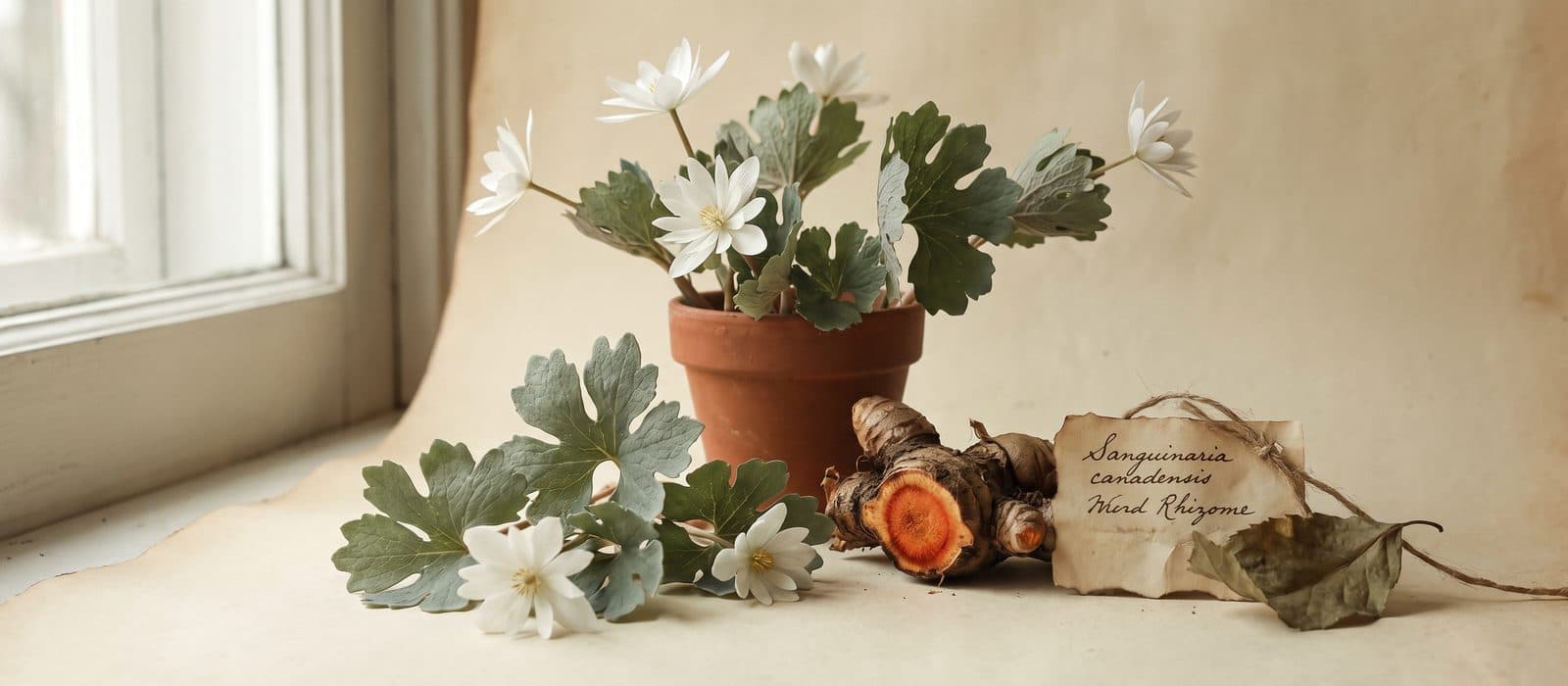
Homeopathic Sanguinaria is prepared from the fresh root, properly a rhizome, of bloodroot, Sanguinaria canadensis. Bloodroot is a low perennial of the eastern North American woodlands and a member of the poppy family (Papaveraceae). In early spring it sends up a single white, star-shaped flower wrapped in one lobed leaf. Break the thick underground stem and it bleeds a red-orange sap, which gave the plant both its English name and its Latin one, from sanguis, blood. Our guide to reading Latin remedy names explains how names like this were formed.
The source needs honest words. The root contains sanguinarine and related alkaloids. Swallowed, bloodroot causes vomiting, burning in the throat and stomach, and in larger amounts collapse; applied to the skin, its sap is corrosive. Caustic "black salves" containing bloodroot have destroyed healthy skin and left deep scars, and medicines regulators have warned against them for years. The raw root is never something to prepare, swallow or put on the skin at home. The homeopathic preparation makes a mother tincture of the fresh root and carries it through repeated dilution and succussion; at the common potencies the arithmetic says no molecule of the root remains. Our potencies guide explains what that means and why it is also the reason mainstream science is sceptical.
Bloodroot also has a long history in North American folk medicine, including as a dye and an emetic, before it reached the homeopathic texts.
What is the Sanguinaria picture?
The Sanguinaria picture is the headache that rises with the sun. Imagine someone who wakes fairly well, then feels a dull ache start at the back of the head mid-morning. By lunchtime it has climbed over the top of the skull and settled, bursting and throbbing, above the right eye. The face is flushed, the cheeks burn in a sharply defined red patch, light and noise are unbearable, and they want a dark room and to lie down. Late in the afternoon, after vomiting or a sleep, it lets go, and by evening they feel almost normal.
Classic texts describe this as the defining Sanguinaria headache: periodic, right-sided, beginning in the occiput and spreading forward to settle over the right eye, often recurring every seventh day in the older reports, and eased by lying down in the dark, by sleep, or by vomiting or passing wind. Boericke (1927) also notes the sun-headache rhythm, rising and falling with the day.
The same congestion shows elsewhere. The materia medica describes burning of the palms and soles that drives the feet out from under the covers, flushes of heat rising to the face, and the hot flushes of the menopause. The right shoulder and upper arm can ache, worse at night and on raising the arm. The nose and throat feel dry, burning and raw, and the older texts discuss it for hay fever with burning, sensitive nostrils and for a dry cough.
The person in the picture is often irritable and morose during the attack, sensitive to everything, and wanting to be left alone in the dark.
What makes it better or worse?
The traditional modalities centre on the sun and the right side. Sanguinaria is worse as the day advances and from light, noise and motion, and better from sleep, darkness and lying down.
| Modality | Worse | Better |
|---|---|---|
| Time | Rising toward midday; periodic, sometimes weekly | Evening; after sleep |
| Senses | Light, noise, smells, jarring | A dark, quiet room |
| Position | Motion, raising the right arm | Lying down, lying still |
| Side | Right side (head, shoulder) | None listed |
| Other | Sweets (Boericke) | Vomiting, passing wind |
Our guide to modalities, better and worse explains why a daily rhythm and a side can matter more than the label "headache".
What is Sanguinaria traditionally discussed for?
In homeopathic literature, Sanguinaria is traditionally discussed for right-sided congestion and waves of flushing heat. Each of these appears on one of our acute pages, where the Sanguinaria-like pattern sits beside its neighbours and the red flags come first.
Head
- A sudden one-sided head pain around the eye, where the right-sided, bursting pain builds to fullness over the eye. That page leads with when one-sided head pain needs urgent assessment.
Heat and flushing
- Burning feet at the end of the day, where flushing heat gathers in the palms and soles alongside facial flushing.
The classic texts also discuss Sanguinaria among the flushing pictures of the menopause; its neighbours in that territory are discussed on a sudden hot flash.
What is Sanguinaria not?
Sanguinaria is not "the migraine remedy" or "the right-sided headache remedy", and no headache picture is a reason to delay medical care for a dangerous headache. Call emergency services for a sudden, severe, "thunderclap" or worst-ever headache, a headache with weakness, numbness, slurred speech, confusion or changed vision, a headache after a head injury, or one with fever, a stiff neck and a rash. A new pattern of headache after the age of fifty, headaches that wake someone from sleep and keep getting worse, or pain around one eye with a red eye and blurred vision all need prompt assessment. Burning feet that persist, especially with numbness or in someone with diabetes, deserve a clinician's look for nerve causes. Our guide to red flags first explains the order.
Homeopaths separate it from its neighbours like this:
| Picture | Where it sits | Defining feature | Key modality |
|---|---|---|---|
| Sanguinaria canadensis | Right-sided headache, flushing | Occiput to right eye; burning palms and soles | Worse as the sun rises; better sleep and dark |
| Spigelia | Left-sided eye neuralgia | Stitching pain above and behind the left eye | Worse touch and motion; rises and falls with the sun |
| Belladonna | Sudden, throbbing heat | Hot, red face, wide pupils, pounding pain | Worse jarring, light and lying flat |
| Glonoin | Sun and heat headaches | Bursting, surging, pulsating head | Worse sun and heat; better cool air |
| Sulphur | Burning feet, hot flushes | Burning soles thrust out of bed; hot, itchy | Worse heat of bed and around 11 a.m. |
What potencies is Sanguinaria sold in?
Sanguinaria canadensis is sold most often as 6C or 30C pellets, usually through homeopathic pharmacies and manufacturers. Potency describes the preparation process, not an amount of root: 30C means thirty successive 1:100 dilutions with succussion between them. Our potencies guide explains the scale and what remains in the vial.
This page deliberately gives no frequency or instructions for taking Sanguinaria. That depends on a whole case, not a remedy name. Read the product label, and talk to a qualified practitioner about an individual situation.
What remedy lists don't tell you
Two things the "remedies for a headache" lists leave out:
- Side and rhythm do most of the sorting. Homeopaths separate one-sided headaches by side and by the clock long before they reach the remedy name: right or left, rising with the sun or arriving at night, eased by sleep or not. Sanguinaria and Spigelia share the sun rhythm and differ by side, which is exactly the kind of detail a list sorted by complaint discards. Our guide to the symptoms alongside the symptom shows how to write those details down.
- The flushing is the thread, not the head. In the classic texts the same remedy covers a right-sided headache, burning feet in bed and menopausal flushes because all three show the same rising, burning congestion. Read only one of them and the picture looks random; read them together and it looks like one person.
Where the Sanguinaria canadensis picture appears on this site
Acute pages that discuss this picture among their educational patterns, with the pattern name each page uses.
- What homeopathic remedy for a sudden one-sided head pain around the eye?Sanguinaria-like right-sided bursting pattern
- What homeopathic remedy for burning feet at the end of the day?Sanguinaria-like flushing palms-and-soles pattern
Not sure whether a picture fits?
A remedy profile describes a picture; it cannot tell you whether that picture matches what you are seeing. An acute consultation starts from the case itself: onset, sensations, what changes it, and the red flags.
Acute consultation · $45Frequently asked questions
- What is Sanguinaria canadensis?
- Sanguinaria canadensis is a homeopathic remedy prepared from the root of bloodroot, a North American woodland plant of the poppy family with red-orange sap. In homeopathy it names a traditional picture of right-sided congestion and flushing: a headache that starts at the back of the head and settles over the right eye, rising and falling with the sun, with burning palms and soles and flushed cheeks. It is a description homeopaths use to compare cases, not a finding that it works for migraine or any other condition.
- What is Sanguinaria used for in homeopathy?
- Homeopathic literature traditionally discusses Sanguinaria for right-sided, bursting headaches that build through the day, for waves of flushing heat with burning in the palms and soles, and for the hot flushes of the menopause. The picture is defined by the right side, the flushing and the daily rhythm, not by the name of the complaint. A sudden, severe or 'worst ever' headache, or one with weakness, confusion or changed vision, needs emergency care first.
- What is Sanguinaria 30C used for?
- 30C is one of the two potencies Sanguinaria is most often sold in, alongside 6C, usually from homeopathic pharmacies rather than general shops. In the tradition the potency does not change the picture; Sanguinaria 30C is discussed for the same right-sided, flushing, sun-rhythm state as any other potency. What 30C means as a dilution is explained in our potencies guide.
- How is Sanguinaria taken?
- This page does not give instructions on how or how often to take any remedy, because that depends on a whole case rather than on a remedy name. The product label carries the manufacturer's directions, and a qualified practitioner can advise on an individual situation. New, severe or changing headaches belong with a clinician first.
- Where can I buy Sanguinaria?
- Homeopathic pharmacies and manufacturers sell Sanguinaria canadensis as single-remedy pellets, usually in 6C or 30C; it is less often found on general shop shelves than the common kit remedies. This site also prepares custom single remedies to order: you name the remedy and potency, and the details are confirmed by email before anything is made. The order form does not give advice on which remedy to choose.
- What is Sanguinaria made from?
- Homeopathic Sanguinaria is prepared from the fresh root of bloodroot, Sanguinaria canadensis, made into a mother tincture and then diluted and succussed step by step to the labelled potency. The raw root and its red sap contain sanguinarine and related alkaloids, which are poisonous if swallowed and corrosive to skin. Bloodroot is never something to prepare, swallow or apply at home.
This guide is educational only and is not medical advice or a personalized remedy recommendation. Acute symptoms can become urgent; when in doubt, seek professional evaluation.