Remedy profile
Thuja occidentalis in Homeopathy: Uses, Picture and Limits
What homeopathic Thuja is made from, the warty, damp-sensitive, fixed-idea picture homeopaths describe, what changes it, the potencies sold, and its limits.
By Homeopathic BenefitsPublished 8 min read
Key takeaways
- Thuja is the picture of overgrowth. Warts, skin tags, thickened or brittle nails and oily skin are its classic physical keynotes.
- Cold and damp aggravate it. Classic texts describe a chilly person who is worse in wet weather and at around 3 a.m. and 3 p.m.
- Fixed ideas colour the mind. The traditional picture includes odd convictions about the body, such as feeling fragile as glass, and a guarded, secretive manner.
- It comes from arborvitae, a common hedge conifer. The foliage and its oil contain thujone, which is toxic in quantity; potentised preparations are diluted far past that point.
- Changing skin growths are a medical question first. A mole or growth that changes, bleeds or itches, and any genital wart, needs a doctor or a sexual health clinic.
The short answer
Thuja occidentalis is a homeopathic remedy prepared from the leafy twigs of arborvitae, or northern white cedar, an evergreen conifer of eastern North America that is planted as a hedge across the world. In homeopathy it names a traditional picture rather than a treatment: a person with warts and other skin overgrowths, oily skin, sensitivity to cold and damp, and fixed, odd ideas about their own body. Classic materia medica places it at the centre of what Hahnemann called sycosis, one of his three underlying constitutional tendencies. Hahnemann recorded it in his Materia Medica Pura, and Boericke (1927) gives warts and fixed ideas a prominent place in its description. It is not a wart remover, and any skin growth that is changing, bleeding or new in adulthood needs a doctor first.
| Latin name | Thuja occidentalis |
|---|---|
| Abbreviation | Thuj. |
| Common name | Arborvitae, northern white cedar |
| Source | Fresh young leafy twigs of Thuja occidentalis (Cupressaceae) (plant kingdom) |
| Commonly sold potencies | 6C, 30C, 200C |
| First proving | Hahnemann, Materia Medica Pura (1811–1821) |
What is Thuja made from?
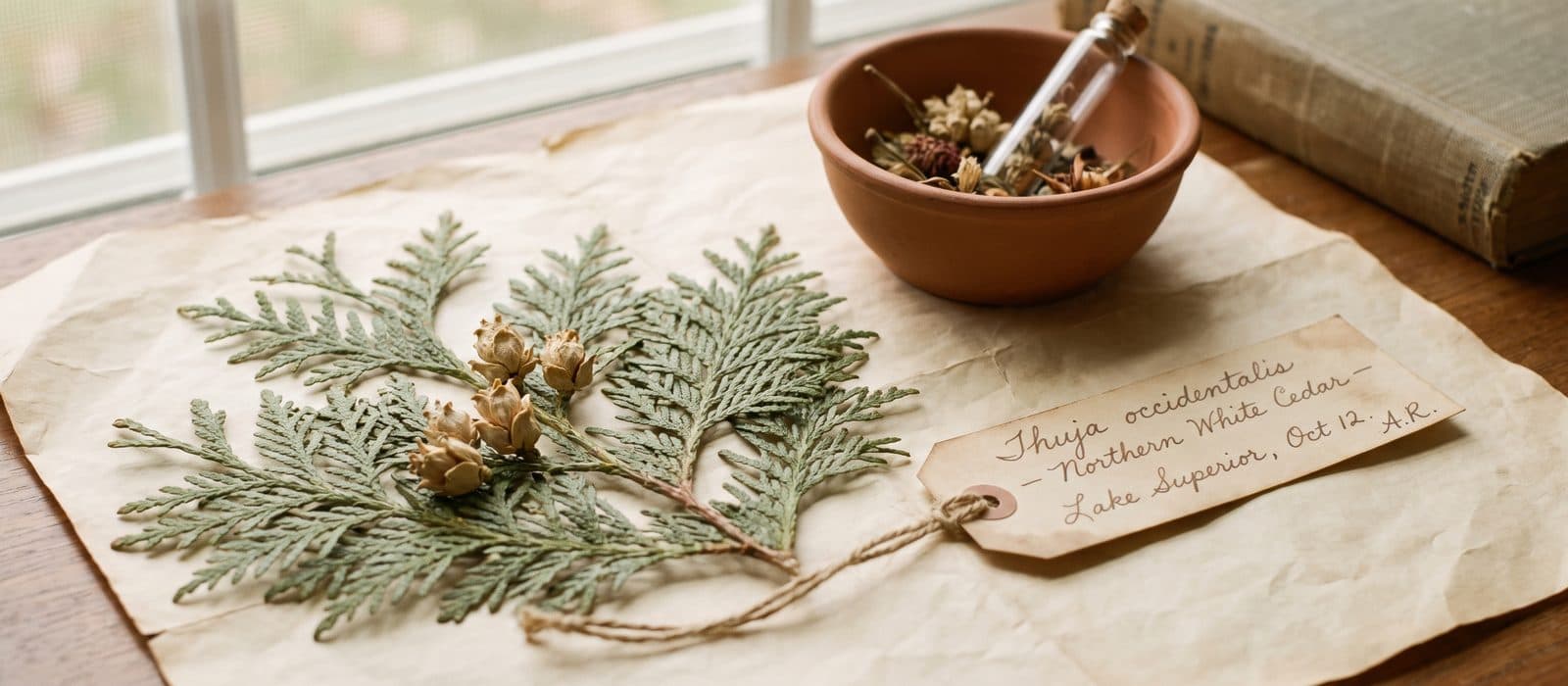
Homeopathic Thuja is prepared from the fresh young leafy twigs of Thuja occidentalis, a slow-growing conifer of the cypress family (Cupressaceae). It is native to the swamps, lake shores and limestone cliffs of eastern Canada and the north-eastern United States, and is one of the most widely planted hedging and screening trees in gardens, sold under names such as 'Emerald' or 'Smaragd'. The flattened, fan-like sprays of scale leaves smell sharp and resinous when crushed.
The name arborvitae, Latin for "tree of life", is often traced to Jacques Cartier's 1535–36 winter on the St Lawrence, when local people showed his scurvy-stricken crew a conifer infusion; whether that tree was Thuja or another evergreen is still debated. Native North American peoples used the tree widely, and it went into European gardens in the sixteenth century.
The foliage and its essential oil contain thujone, a compound that is toxic to the nervous system and can cause seizures in quantity; cedar-leaf oil has caused poisonings. The plant is not something to brew, swallow or prepare at home. The homeopathic preparation starts from a mother tincture of the fresh twigs, then dilutes and succusses it step by step to the labelled potency. At the common potencies the arithmetic says no molecule of the original plant remains. Our potencies guide explains that honestly, including why it is also the reason mainstream science is sceptical.
What is the Thuja picture?
The Thuja picture is easiest to see in the skin. Classic texts describe warts that are large, soft, fleshy or cauliflower-like, sometimes bleeding easily, on the hands, face or genitals; skin tags; brown spots; brittle, crumbling or distorted nails; and oily, greasy skin with sweat on the uncovered parts of the body. Boericke (1927) sums up the physical side as a tendency to overgrowth of skin and mucous membranes.
The mind is quieter and harder to read. Kent's Lectures (1905) and Clarke's Dictionary (1900–1902) describe a person with fixed ideas, often strange ones: that the body is fragile and might break, that someone is walking beside them, that something is alive in the abdomen, or that body and soul are separate. Underneath sits a sense of being somehow wrong or unacceptable, kept hidden behind a careful, guarded manner. Imagine someone polite and meticulous who will not quite tell you what is bothering them, and who mentions only at the end of a long conversation the warts they have been hiding for years.
The rest of the picture is chilly and damp-sensitive. The person feels worse in cold, wet weather, at around 3 a.m. and 3 p.m., and from onions, fat and coffee in the classic lists, and the left side is more often affected. Hahnemann linked the whole picture to sycosis, his name for a constitutional tendency to overgrowth and discharges. That theory belongs to the history of homeopathy rather than to modern medicine, but it explains why Thuja is so often discussed in long-standing cases rather than acute ones.
What makes it better or worse?
The traditional modalities centre on damp, cold and the clock. Thuja is worse in cold, wet weather and at night, and better in warmth and dry air.
| Modality | Worse | Better |
|---|---|---|
| Weather | Cold, damp, wet weather | Dry, warm weather |
| Time | Night; around 3 a.m. and 3 p.m. | Daytime |
| Temperature | Cold air; also the heat of the bed at night (Boericke) | Warm wind; free perspiration |
| Food | Onions, fat, coffee, tea | No consistent keynote |
| Side and position | Left side more often than right | Drawing up a limb (Boericke) |
Our guide to modalities, better and worse explains why a homeopath reads these before any remedy name.
What is Thuja traditionally discussed for?
In homeopathic literature, Thuja is traditionally discussed mainly in long-standing, constitutional cases. None of our acute pages names a Thuja-like pattern yet; the groups below follow the classic texts.
Skin
- Warts, especially soft, fleshy, cauliflower-like or easily bleeding ones; skin tags; brown spots; oily skin; sweat on uncovered parts.
Nails and hair
- Brittle, soft, crumbling or distorted nails; dry hair. These appear in Boericke as part of the overgrowth picture.
Eyes
- Classic texts discuss Thuja for small hard lumps on the eyelids and recurring styes. Our page on a stye on the eyelid covers the acute version with its red flags and the Staphysagria-like stye-after-stye pattern that sits closest to Thuja.
Mind
- Fixed ideas about the body, low self-worth kept hidden, and a guarded, secretive manner.
After vaccination (historical)
- Some nineteenth-century homeopaths, most influentially J. Compton Burnett in 1884, discussed Thuja for what they called "vaccinosis", ill effects they attributed to smallpox vaccination. That idea is historical, not evidence; see the next section.
Because most of this material is constitutional, it belongs with a practitioner taking a full case over time; our guide to acute versus chronic explains the difference.
What is Thuja not?
Thuja is not a wart remover, and not a reason to leave a skin growth unchecked. Most warts are harmless and many clear on their own, but a mole or growth that changes in size, shape or colour, bleeds, itches or appears new in adulthood needs a doctor, because some skin cancers start this way. Warts on the genitals are a sexually transmitted infection and belong with a sexual health clinic or doctor, who can also discuss HPV vaccination and cervical screening.
Thuja is also not an alternative to vaccination or an antidote to it. The "vaccinosis" idea is a nineteenth-century theory that predates modern immunology, and this site does not suggest avoiding or "clearing" vaccines. For a sore arm after a vaccine, our page on a sore arm after a vaccine sets out the normal reaction and the red flags. Our guide to homeopathy and the evidence is candid about what is and is not known.
Homeopaths separate it from its neighbours like this:
| Picture | Where it sits | Defining feature | Key modality |
|---|---|---|---|
| Thuja occidentalis | Overgrowth, damp, fixed ideas | Soft, fleshy or cauliflower warts; oily skin; guarded, feels fragile | Worse cold damp and 3 a.m.; better warmth |
| Causticum | Old, hard warts | Hard, horny warts near the nails and on the face; sympathetic, sense of injustice | Worse dry cold; better damp weather |
| Antimonium crudum | Horny skin and thick nails | Smooth, horny warts and calluses; white-coated tongue; sulky | Worse heat of the sun and cold bathing |
| Natrum sulphuricum | Damp-sensitive constitution | Worse every damp day; heavy, low-spirited | Worse damp weather and basements; better dry air |
Thuja and Natrum sulphuricum share the damp aggravation, and classic texts group both under Hahnemann's sycosis. What separates them is the skin: overgrowth and warts lead in Thuja, the heavy, damp-weather gloom in Natrum sulphuricum.
What potencies is Thuja sold in?
Thuja is sold most often as 30C pellets, the common shelf potency for single remedies, with 6C and 200C also widely available. It is also sold as low-potency tinctures and creams applied to the skin, which carry their own labelling. Potency describes the preparation process, not an amount of plant: 30C means thirty successive 1:100 dilutions with succussion between them. Our potencies guide explains the scale and what remains in the vial.
This page deliberately gives no frequency or instructions for taking Thuja. That depends on a whole case, not a remedy name. Read the product label, and talk to a qualified practitioner about an individual situation.
What remedy lists don't tell you
Two things the "remedies for warts" lists leave out:
- The wart is the least individual part of the case. Lists put Thuja first for warts because the classic texts mention warts so often. But the classic authors chose between Thuja, Causticum and Antimonium crudum by the kind of wart and, more often, by the person: the guarded, chilly, damp-sensitive one with fixed ideas reads as Thuja; the sympathetic one with hard warts by the nails does not. A list sorted by complaint loses the half of the description that did the choosing.
- Much of Thuja's reputation comes from a theory, not an observation. Hahnemann's sycosis and Burnett's vaccinosis shaped how Thuja was written about for a century. Both are useful for reading old texts and neither is supported by modern evidence. Knowing that history makes it easier to see which parts of the picture are observation (the skin, the modalities) and which are interpretation.
Not sure whether a picture fits?
A remedy profile describes a picture; it cannot tell you whether that picture matches what you are seeing. An acute consultation starts from the case itself: onset, sensations, what changes it, and the red flags.
Acute consultation · $45Frequently asked questions
- What is Thuja occidentalis?
- Thuja occidentalis is a homeopathic remedy prepared from the leafy twigs of arborvitae, or northern white cedar, a conifer of eastern North America often planted as a hedge. In homeopathy it names a traditional picture: warty, overgrown skin, oily skin, sensitivity to cold and damp, and odd fixed ideas about the body, such as feeling fragile. It is a description homeopaths use to compare cases, not a finding that it works for warts or any other condition.
- What is Thuja used for in homeopathy?
- Homeopathic literature traditionally discusses Thuja for skin growths, above all warts, along with oily skin, brittle or distorted nails, and a person who is worse in cold, damp weather. In classical homeopathy it is one of the central constitutional pictures of what Hahnemann called sycosis. A mole or growth that changes, bleeds or itches, or any genital wart, needs a doctor or sexual health clinic first.
- What is Thuja 30C used for?
- 30C is the common shelf potency of Thuja, the one most single-remedy tubes carry. In the tradition the potency does not change the picture; Thuja 30C is discussed for the same warty, damp-sensitive picture as any other potency. Thuja is also sold as low-potency tinctures and creams for the skin, which carry their own labelling. Our potencies guide explains what 30C means as a dilution.
- How is Thuja taken?
- This page does not give instructions on how or how often to take any remedy, because that depends on a whole case rather than on a remedy name. The product label carries the manufacturer's directions, and a qualified practitioner can advise on an individual situation. Any skin growth that is changing, bleeding or new in adulthood should be seen by a doctor first.
- Where can I buy Thuja?
- Pharmacies, health-food shops and homeopathic manufacturers sell Thuja occidentalis as single-remedy pellets, most often in 30C, and as tinctures and creams. This site also prepares custom single remedies to order: you name the remedy and potency, and the details are confirmed by email before anything is made. The order form does not give advice on which remedy to choose.
- What is Thuja made from?
- Homeopathic Thuja is prepared from the fresh young leafy twigs of Thuja occidentalis, arborvitae. They are made into a mother tincture, then diluted and succussed step by step to the labelled potency. The raw foliage and its essential oil contain thujone, which is toxic to the nervous system in quantity, so the plant is not something to brew or take at home.
This guide is educational only and is not medical advice or a personalized remedy recommendation. Acute symptoms can become urgent; when in doubt, seek professional evaluation.