Remedy profile
Natrum sulphuricum in Homeopathy: Uses, Picture and Limits
What homeopathic Natrum sulphuricum is made from, the damp-weather, liverish picture homeopaths describe, what changes it, potencies sold, and its limits.
By Homeopathic BenefitsPublished 7 min read
Key takeaways
- Damp is the defining modality. Classic texts describe a person who is worse in wet weather, near water, and in damp houses, and better when the weather turns dry.
- The morning is the classic worse time. Loose stools with a lot of wind soon after getting up, and a heavy head on waking, run through the descriptions.
- It has a liverish, after-excess side. Homeopaths compare it with Nux vomica for the dull, heavy, bilious hangover headache.
- It is Glauber's salt, sodium sulphate. It is one of Schüssler's twelve tissue salts, sold most often as 6X.
- Head injury and breathing come first. Any head injury with drowsiness, vomiting or confusion, any wheeze that makes speaking hard, and any thoughts of suicide (in the US, call or text 988) need urgent care before any pattern discussion.
The short answer
Natrum sulphuricum is a homeopathic remedy and Schüssler tissue salt prepared from sodium sulphate, the white salt known since the seventeenth century as Glauber's salt, ground with milk sugar and potentised. In homeopathy it names a traditional picture shaped by damp: a person who is worse in wet weather and in the morning, with loose morning stools and wind, a heavy, liverish head, and a low, serious mood. The classic texts are also known for linking it with mental changes after a head injury. It entered the materia medica through nineteenth-century provings and Schüssler's tissue-salt scheme. It is not a hangover remedy or a head-injury remedy, and a head injury with any warning signs needs emergency care, not a pattern match.
| Latin name | Natrum sulphuricum |
|---|---|
| Abbreviation | Nat-s. |
| Common name | Sodium sulphate (Glauber's salt); tissue salt no. 10 (Nat sulph) |
| Source | Sodium sulphate, a white mineral salt, triturated with milk sugar and potentised (mineral kingdom) |
| Commonly sold potencies | 6X, 6C, 30C |
| First proving | Nineteenth-century provings recorded in Allen's Encyclopedia of Pure Materia Medica (1874–1879); also one of Schüssler's twelve tissue salts (1873) |
What is Natrum sulphuricum made from?
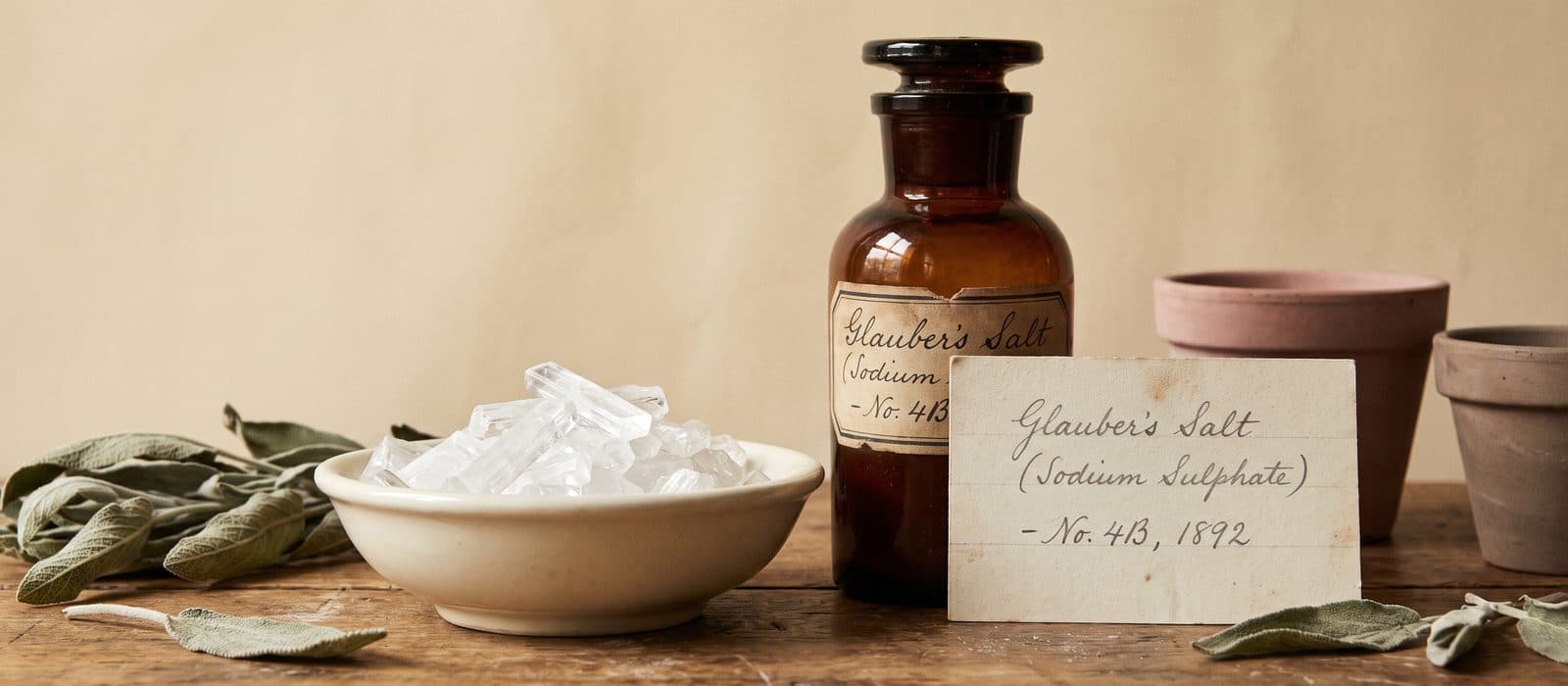
Natrum sulphuricum is prepared from sodium sulphate (Na₂SO₄), a white crystalline salt. The German-Dutch chemist Johann Rudolf Glauber made it from spring water and sulphuric acid in the seventeenth century and called it sal mirabile, the miraculous salt; for the next three hundred years "Glauber's salt" was a standard purgative. Today it is used mainly in detergents, paper-making and glass. In the old chemical naming, natrum is sodium and sulphuricum is sulphate, so Nat-s. on a label is a different remedy from Nat-m., table salt. Our guide to reading Latin remedy names explains how easily those two get confused.
The tissue-salt form is triturated with lactose and pressed into tablets at 6X, one part in a million, far below any purging effect; homeopathic pharmacies also prepare it on the centesimal scale. Sodium sulphate is not poisonous in ordinary amounts. Our potencies guide explains the X and C scales, and why the dilution itself is the reason mainstream science is sceptical.
What is the Natrum sulphuricum picture?
The Natrum sulphuricum picture is a person whom damp gets into. Classic texts describe someone who feels every wet spell: the joints stiffen, the chest tightens, the head is heavy, and the mood sinks when the weather turns wet or when they live in a damp house or near water. Von Grauvogl, a nineteenth-century German homeopath, built a whole "hydrogenoid" constitution around this sensitivity to damp, and Natrum sulphuricum became its central remedy.
The digestive side is liverish and windy. Boericke (1927) describes a bitter taste, a dirty greenish-grey coating at the back of the tongue, a sore, sensitive liver area, and loose stools that come with a rush of wind soon after rising in the morning. The head is dull and heavy, especially on waking and after excess, which is why our acute pages compare it with Nux vomica for the hangover headache.
The mental picture is serious and low. The old texts describe sadness that is worse in the morning and in wet weather, made worse by music, and a person who is irritable and does not want to talk. Boericke records a suicidal tendency held in check by duty to family. If that describes you or someone close, it is a mental-health emergency, not a remedy question: in the US, call or text 988; elsewhere, contact local emergency services.
The classic texts also link the picture with the after-effects of a head injury: headaches, low mood, irritability or changed behaviour that began after a blow to the head, sometimes long before. Any of those needs a medical assessment first.
What makes it better or worse?
The traditional modalities centre on damp and the morning. Natrum sulphuricum is worse from damp weather and on waking, and better in dry weather and from changing position.
| Modality | Worse | Better |
|---|---|---|
| Weather | Damp, wet weather; damp houses; near water | Dry weather |
| Time | Morning, on waking; soon after rising | Later in the day |
| Position | Lying on the left side | Changing position |
| Mood | Music; wet weather | Open air |
| Touch | Pressure over the liver area | Holding the chest while coughing |
The damp-weather modality is general, not tied to one complaint. Our guides to modalities, better and worse and seasonal acute patterns explain why homeopaths give weather so much weight.
What is Natrum sulphuricum traditionally discussed for?
In homeopathic literature, Natrum sulphuricum is traditionally discussed for complaints shaped by damp and the morning. One of our acute pages names it as a pattern; the others below are acute pages where the complaint lives and the red flags come first, with the Natrum sulphuricum picture coming from the classic texts.
After drinking
- The dull, heavy, liverish head the morning after: a hangover headache, where it sits beside Nux vomica. Our guide to hangovers, rich food and bad food reads those cases side by side.
Digestion
- Loose stools with a rush of wind soon after rising: sudden diarrhoea.
- Rumbling, windy bloating with a bitter taste: gas pains with bloating.
Chest
- A loose cough with thick phlegm, worse in wet weather and better holding the chest: a wet, productive cough. Classic texts also describe wheezing in damp weather. Any wheeze that makes speaking hard, blue lips, or breathing that is getting worse needs emergency care.
After a head injury (classic texts)
- The old literature discusses it for lasting headaches or mood change after a blow to the head. A recent head injury with drowsiness, repeated vomiting, confusion, a severe headache or a seizure is an emergency; later changes after a head injury need a doctor.
What is Natrum sulphuricum not?
Natrum sulphuricum is not "the head-injury remedy", and it is not a hangover cure. The commonest misreading is to take the head-injury keynote from a list and apply it to a fresh knock, which is exactly the moment when the person needs watching for medical warning signs. The tradition's picture is the combination: aggravation from damp, the morning, windy loose stools, a heavy liverish head and a low, serious mood. A hangover without the damp-weather and morning shape belongs elsewhere.
Homeopaths separate Natrum sulphuricum from its neighbours like this:
| Picture | Where it sits | Defining feature | Key modality |
|---|---|---|---|
| Natrum sulphuricum | Damp-weather, liverish, morning complaints | Heavy head, windy morning stools, serious low mood | Worse damp and morning; better dry weather |
| Nux vomica | After rich food, alcohol, overwork | Irritable, chilly, oversensitive; ineffectual urging | Worse early morning; better a short sleep |
| Natrum muriaticum | Reserved, long-held grief | Dwells on past hurts; headaches from the sun | Worse sun and consolation; better alone |
| Arnica montana | Fresh injury and bruising | Sore, bruised, says they are fine | Worse touch and jarring |
| Bryonia | Dry, irritable, still | Wants to lie completely still; very thirsty | Worse the slightest motion; better pressure |
| Thuja occidentalis | Damp-sensitive, overgrowth | Soft, fleshy warts; oily skin; guarded, feels fragile | Worse cold damp and 3 a.m.; better warmth |
What potencies is Natrum sulphuricum sold in?
Natrum sulphuricum is sold most often as 6X tissue-salt tablets, labelled Nat sulph or tissue salt no. 10, and also as 6C and 30C pellets. 6X means six successive 1:10 dilutions, one part in a million; 30C means thirty successive 1:100 dilutions with succussion between them. Our potencies guide explains both scales and what remains in the vial.
This page deliberately gives no frequency or instructions for taking Natrum sulphuricum. That depends on a whole case, not a remedy name. Read the product label, and talk to a qualified practitioner about an individual situation.
What remedy lists don't tell you
Two things the short lists leave out:
- Weather is the case. Most people do not notice that they are worse in damp weather until someone asks. The useful question for this picture is not "what is the complaint?" but "when is it worse?": wet spells, a basement flat, a holiday by a lake. A homeopath reading a recurring morning complaint will ask about the weather and the house before anything else. Our guide to red flags first covers what to check before that.
- Two traditions meet in one vial. The homeopathic picture of damp, liver and mood comes from nineteenth-century provings and von Grauvogl's constitutional theory; the tissue-salt version comes from Schüssler, who saw sodium sulphate as the salt that regulates water in the tissues. Schüssler's chemistry has not held up, but the two traditions agree on damp, and the tablets on a shop shelf usually come from the second.
Where the Natrum sulphuricum picture appears on this site
Acute pages that discuss this picture among their educational patterns, with the pattern name each page uses.
- What homeopathic remedy for a hangover headache?Natrum sulphuricum-like head-heavy, liver-fatigue pattern
Not sure whether a picture fits?
A remedy profile describes a picture; it cannot tell you whether that picture matches what you are seeing. An acute consultation starts from the case itself: onset, sensations, what changes it, and the red flags.
Acute consultation · $45Frequently asked questions
- What is Natrum sulphuricum?
- Natrum sulphuricum is a homeopathic remedy and Schüssler tissue salt prepared from sodium sulphate, the old purging salt known as Glauber's salt, ground with milk sugar and then potentised. In homeopathy it names a traditional picture: a person who is worse in damp weather and in the morning, with liverish digestion, a heavy head and a low mood. It is a description homeopaths use to compare cases, not evidence that it works for any condition.
- What is Natrum sulphuricum used for in homeopathy?
- Homeopathic literature traditionally discusses Natrum sulphuricum for complaints worse in damp weather: loose morning stools with wind, a heavy, liverish head after excess, and a loose cough or wheeze in wet weather. It is also known in the classic texts for mental changes after a head injury. Any head injury with drowsiness, vomiting or confusion, and any breathing difficulty, needs urgent medical care first.
- What is Natrum sulphuricum 30C used for?
- Natrum sulphuricum is sold as a 6X tissue salt and also as 6C and 30C pellets. In the tradition the potency does not change the picture; 30C is discussed for the same damp-weather, liverish, heavy-headed picture as any other potency. Our potencies guide explains what the X and C scales mean.
- How is Natrum sulphuricum taken?
- This page does not give instructions on how or how often to take any remedy or tissue salt, because that depends on a whole case rather than on a remedy name. The product label carries the manufacturer's directions, and a qualified practitioner can advise on an individual situation. A head injury, wheezing that makes speaking hard, or persistent diarrhoea needs medical care first.
- Where can I buy Natrum sulphuricum?
- Pharmacies, health-food shops and homeopathic manufacturers sell Natrum sulphuricum, most often as 6X tissue-salt tablets labelled Nat sulph or tissue salt no. 10, and also as 30C pellets. This site also prepares custom single remedies to order: you name the remedy and potency, and the details are confirmed by email before anything is made. The order form does not give advice on which remedy to choose.
- What is Natrum sulphuricum made from?
- Natrum sulphuricum is made from sodium sulphate, the white salt the seventeenth-century chemist Johann Rudolf Glauber called sal mirabile and which was long sold as a purgative. In old chemical naming, natrum means sodium. It is ground with milk sugar and then potentised; the 6X tissue salt is a one-in-a-million dilution with no purging action.
This guide is educational only and is not medical advice or a personalized remedy recommendation. Acute symptoms can become urgent; when in doubt, seek professional evaluation.