Remedy profile
Aurum metallicum in Homeopathy: Uses, Picture and Limits
What homeopathic Aurum metallicum is made from, the dutiful, heavy-hearted picture homeopaths describe, what changes it, potencies sold, and its limits.
By Homeopathic BenefitsPublished 7 min read
If you are having thoughts of suicide or of harming yourself, please get help now. In the US, call or text 988 (the Suicide and Crisis Lifeline). Elsewhere, call your local emergency number or go to the nearest emergency department. This page is about a historical remedy description; it cannot help in a crisis, and the people at those numbers can.
Key takeaways
- Aurum metallicum is a picture of heavy-heartedness with duty. Classic texts describe a serious, responsible, high-achieving person who feels they have failed and blames themselves.
- The old descriptions are blunt about despair. Boericke (1927) and Kent (1905) list loathing of life and thoughts of suicide among its keynotes. Today those are a mental-health emergency first, whatever any remedy text says.
- Night and winter are the classic worse times. Bone pains and low mood are described as worse from sunset to sunrise and in cold weather.
- It is prepared from pure gold. Metallic gold is inert; the remedy is triturated with milk sugar and potentised.
- Mood, heart and blood pressure are medical questions first. Persistent low mood, chest pain, palpitations, and high blood pressure need a doctor, not a pattern match.
The short answer
Aurum metallicum is a homeopathic remedy prepared from pure metallic gold, ground with milk sugar and then diluted and succussed to the labelled potency. In homeopathy it names a traditional constitutional picture: a conscientious, serious person, often successful and responsible for others, who sinks into a heavy, self-reproaching low mood after a failure, loss or disgrace. Hahnemann published its proving in the Materia Medica Pura, and the later classic texts place it among the major remedies of depression with congestion of the heart and circulation. It is not a treatment for depression or heart disease, and anyone with thoughts of suicide needs urgent help, in the US by calling or texting 988.
| Latin name | Aurum metallicum |
|---|---|
| Abbreviation | Aur. |
| Common name | Metallic gold |
| Source | Pure metallic gold, finely divided and triturated with milk sugar, then potentised (mineral kingdom) |
| Commonly sold potencies | 6C, 30C, 200C |
| First proving | Hahnemann, Materia Medica Pura (vol. 4, 1818); later included in The Chronic Diseases |
What is Aurum metallicum made from?
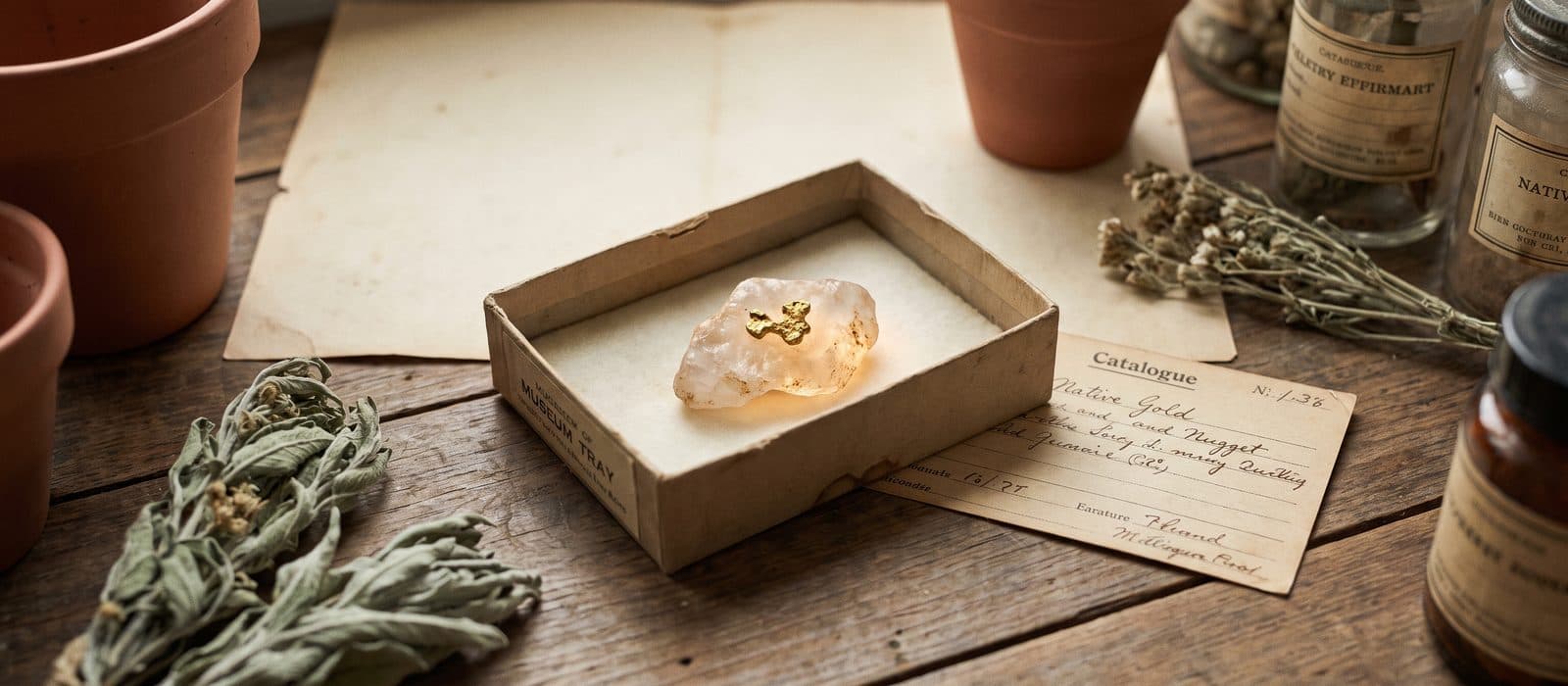
Homeopathic Aurum metallicum is prepared from pure metallic gold. Because gold does not dissolve in water or alcohol, the first potency steps are made by trituration: gold leaf or finely powdered gold is ground with lactose for hours before the triturate is carried into liquid and then diluted and succussed in the usual way. Aurum is simply the Latin for gold, and metallicum distinguishes the metal from gold salts such as Aurum muriaticum. Our guide to reading Latin remedy names explains how these label names work.
Gold has a long history in medicine. Medieval and Renaissance physicians gave "potable gold" for melancholy and for the heart, and Hahnemann, in his introduction to the remedy, discussed those old claims before carrying out his own proving. Metallic gold itself is inert: it is not absorbed and is not poisonous. Some gold salts used in twentieth-century medicine had real toxic effects, but they are a different substance.
At 12C the dilution passes the Avogadro limit, and the arithmetic says no atom of the original gold is expected to remain in a properly prepared remedy. That is also the reason mainstream science is sceptical of the method. Our potencies guide works through both sides.
What is the Aurum metallicum picture?
The Aurum metallicum picture is a person of duty. Classic texts describe someone serious, principled and ambitious, who takes responsibility seriously and holds themselves to a high standard: the provider, the manager, the person others rely on. The picture appears when that structure gives way. A business fails, a reputation is damaged, a responsibility goes unmet, and the person turns the failure inward. Kent (1905) describes a profound sense of worthlessness, of having neglected their duty, and of life having lost its value.
The low mood in this picture is heavy and dark rather than tearful. The person may be irritable and quick to anger when contradicted, then sink back into silence. The old texts state plainly that loathing of life and thoughts of suicide belong to it. They are listed here because they are part of the historical record, and because anyone reading them in themselves or someone close should know that this is a medical and mental-health emergency, not a matter for a remedy. Call or text 988 in the US, or local emergency services elsewhere.
Physically, the nineteenth-century descriptions centre on congestion: a flushed face, a sense of the blood rushing up, palpitations, and what the texts call heart symptoms and high blood pressure. They also describe bone pains, notably of the skull and the nose, worse at night, and complaints of the testes. Many of those descriptions come from an era when mercury treatment and syphilis shaped clinical pictures, and they read differently today. Each of them belongs with a doctor first.
What makes it better or worse?
The traditional modalities centre on night, cold and solitude. Aurum metallicum is described as worse at night and in winter, and later writers add that it is better from music and from walking in the open air.
| Modality | Worse | Better |
|---|---|---|
| Time | Night, from sunset to sunrise | Daytime |
| Season and temperature | Winter, getting cold | Warmth, warm weather |
| Mood | Contradiction; reflecting on failures | Music (in later writers) |
| Activity | Mental strain and overwork | Walking in the open air |
| Company | Being consoled can irritate | No consistent keynote |
These are general modalities, typical of a constitutional picture. Our guide to modalities, better and worse explains how homeopaths use them.
What is Aurum metallicum traditionally discussed for?
Aurum metallicum is not named on any of our acute pages, and that is deliberate: its picture is a constitutional one, and its central feature, deep low mood, is not an acute self-care question. What follows comes from the classic materia medica, with each item framed as the medical question it is first.
Mood (classic texts)
- Kent (1905), Clarke (1900–1902) and Boericke (1927) traditionally discuss Aurum for profound, self-reproaching low mood after failure, loss of position or disgrace, in a serious and responsible person. Depression is a medical condition with effective care; a homeopath working responsibly does so alongside a doctor or therapist, as our guide to homeopathy alongside conventional care sets out.
- Grief and shock in the acute sense are a different question. Our page on exhaustion after bad news discusses the acute pictures homeopaths compare there, with the red flags first.
Heart and circulation (classic texts)
- The older literature discusses Aurum for congestion, palpitations and what it calls high blood pressure in a flushed, heavy-hearted person. Chest pain, palpitations, breathlessness and raised blood pressure are always a medical question; our guide to red flags first explains the principle.
Bones and nose (historical)
- Nineteenth-century texts describe night-time bone pains of the skull and nose. These descriptions come largely from the era of mercury and syphilis and are recorded here for completeness, not as a guide to any current complaint.
What is Aurum metallicum not?
Aurum metallicum is not "the homeopathic remedy for depression", and it is not an alternative to mental-health care. The commonest misreading takes the word "suicidal" from a remedy list and attaches it to a remedy name, which is exactly backwards: thoughts of suicide are a reason to get urgent help, in the US by calling or texting 988, and a reason to see a doctor, not a reason to look anything up. The tradition's Aurum picture is a whole person, the dutiful achiever turned against themselves, with night-time aggravation and congestion; but even a perfect match on paper does not change what the person needs first.
Homeopaths separate Aurum metallicum from its neighbours like this:
| Picture | Where it sits | Defining feature | Key modality |
|---|---|---|---|
| Aurum metallicum | Heavy, self-reproaching low mood | Sense of failed duty; serious, responsible, angry when contradicted | Worse at night and in winter |
| Ignatia amara | Acute grief and disappointment | Sighing, lump in the throat, changeable and contradictory | Worse consolation; worse coffee and tobacco |
| Natrum muriaticum | Long-held, silent grief | Reserved, dwells on past hurts, dislikes fuss | Worse consolation and sun; better alone |
| Sepia | Worn-out, flat, indifferent | Indifference to those close to them, rather than self-blame | Better vigorous exercise |
| Natrum sulphuricum | Low mood in damp weather or after head injury | Restrained by duty to family; damp-weather complaints | Worse damp; worse morning |
What potencies is Aurum metallicum sold in?
Aurum metallicum is sold most often as 30C pellets, with 6C and 200C available from homeopathic manufacturers and specialist pharmacies; it is less common on general shop shelves than the acute remedies. Potency describes the preparation process, not an amount of gold: 30C means thirty successive 1:100 dilutions with succussion between them. Our potencies guide explains the scale and what remains in the vial.
This page deliberately gives no frequency or instructions for taking Aurum metallicum. That depends on a whole case, not a remedy name, and a constitutional picture with this one's history is the territory of a practitioner working alongside medical care. Read the product label, and talk to a qualified practitioner about an individual situation.
What remedy lists don't tell you
Two things the short lists leave out:
- The keynote is duty, not sadness. Lists that reduce Aurum metallicum to "depression" miss what distinguishes it in the classic texts: the person's sense of responsibility, and the self-reproach that follows when they believe they have failed it. Two people with the same low mood can have entirely different stories behind it, which is why a homeopath takes a full case. Our guide to how a homeopath takes a case explains what that involves.
- The old texts are frank, and that frankness has a job. It can be uncomfortable to read a remedy description that lists despair and suicide so plainly. The honest reading is that nineteenth-century physicians recorded what they saw. The responsible reading today is that those words are a signal to get help: in the US, call or text 988; elsewhere, contact local emergency services or a doctor the same day.
Not sure whether a picture fits?
A remedy profile describes a picture; it cannot tell you whether that picture matches what you are seeing. An acute consultation starts from the case itself: onset, sensations, what changes it, and the red flags.
Acute consultation · $45Frequently asked questions
- What is Aurum metallicum?
- Aurum metallicum is a homeopathic remedy prepared from pure metallic gold, ground with milk sugar and then diluted and succussed. In homeopathy it names a traditional constitutional picture: a serious, conscientious person weighed down by a sense of having failed in their duty, with a heaviness of mood the classic texts describe in strong terms. It is a description homeopaths use to compare cases, not evidence that it works for any condition, and it is not a substitute for care for depression.
- What is Aurum metallicum used for in homeopathy?
- Homeopathic literature discusses Aurum metallicum mainly as a constitutional picture of deep low mood with self-reproach, alongside older descriptions of heart, circulation and bone complaints worse at night. Every one of those is a medical question first. Anyone having thoughts of suicide should get urgent help now: in the US, call or text 988; elsewhere, contact local emergency services.
- What is Aurum metallicum 30C used for?
- 30C is a common shelf potency of Aurum metallicum, alongside 6C and 200C. In the tradition the potency does not change the picture, and Aurum is a constitutional remedy that homeopaths usually leave to a practitioner who has taken a full case. Low mood that persists, or any thoughts of self-harm, need medical and mental-health care rather than a remedy decision.
- How is Aurum metallicum taken?
- This page does not give instructions on how or how often to take any remedy, because that depends on a whole case rather than on a remedy name. The product label carries the manufacturer's directions, and a qualified practitioner can advise on an individual situation. Depression, chest pain, palpitations or high blood pressure belong with a doctor first.
- Where can I buy Aurum metallicum?
- Homeopathic manufacturers and specialist pharmacies sell Aurum metallicum as single-remedy pellets, most often in 30C; it is less common on general shop shelves than the acute remedies. This site also prepares custom single remedies to order: you name the remedy and potency, and the details are confirmed by email before anything is made. The order form does not give advice on which remedy to choose.
- What is Aurum metallicum made from?
- Aurum metallicum is made from pure metallic gold. Gold leaf or finely divided gold is ground with milk sugar for long periods (trituration) through the first potency steps, then diluted and succussed to the labelled potency. Metallic gold itself is inert and is not poisonous, unlike some gold salts used in older medicine.
This guide is educational only and is not medical advice or a personalized remedy recommendation. Acute symptoms can become urgent; when in doubt, seek professional evaluation.